From the blog
Stussy Gray Hoodie: Fit, Sizing, and Use Guide
Introduction If you're considering buying a stussy gray hoodie, the first thing to figure out isn't "does gray go with everything?" but whether the product page...
Introduction
If you're considering buying a stussy gray hoodie, the first thing to figure out isn't "does gray go with everything?" but whether the product page provides enough information to support a controlled purchase decision. This article only uses the product category information, page images, and purchase process notes currently visible on fashion-reps to organize a verification method. It does not treat unshown size charts, fabric composition, stock, real-life QC photos, or user feedback as confirmed facts. Page information verification date: October 18, 2026.
This article is for buyers who want to judge fit, sizing, and fall/winter use boundaries before ordering. If you already have the full product page, detailed measurements, and QC photos, you can plug them into the checklist below. If the page lacks key specs, the conclusion should be to hold off on ordering, not to guess based on a familiar brand name. 🧭
The Scope of This stussy Gray Hoodie Purchase Decision
The main question in this check is: does the visible product information let you judge the fit and wearing scenarios of a gray hoodie?
After reading, you should be able to do three things:
- Determine whether the page provides enough size and structure information.
- Compare your own body measurements item by item with the product size chart, instead of just ordering your usual letter size.
- Distinguish between facts the page can prove, clues the images can only suggest, and information you must wait for QC or the seller to provide.
This article does not apply to scenarios that require confirming authenticity, authenticating the brand, predicting final received quality, or calculating the complete landed cost. The current visible information is not enough to support these conclusions, and there are no complete physical measurements or order records provided for review.
fashion-reps' page identity is a product discovery and review entry point. The page explains that buyers can view product information and proceed with orders through selected shopping agents; payment, orders, and logistics are handled by external agent websites. Therefore, the reference price on the product page cannot be directly equated to the final payment amount, nor can it replace checking stock, shipping, taxes, and after-sales policies on the agent's side. 💡
What Visible Specs to Check First on the Product Page
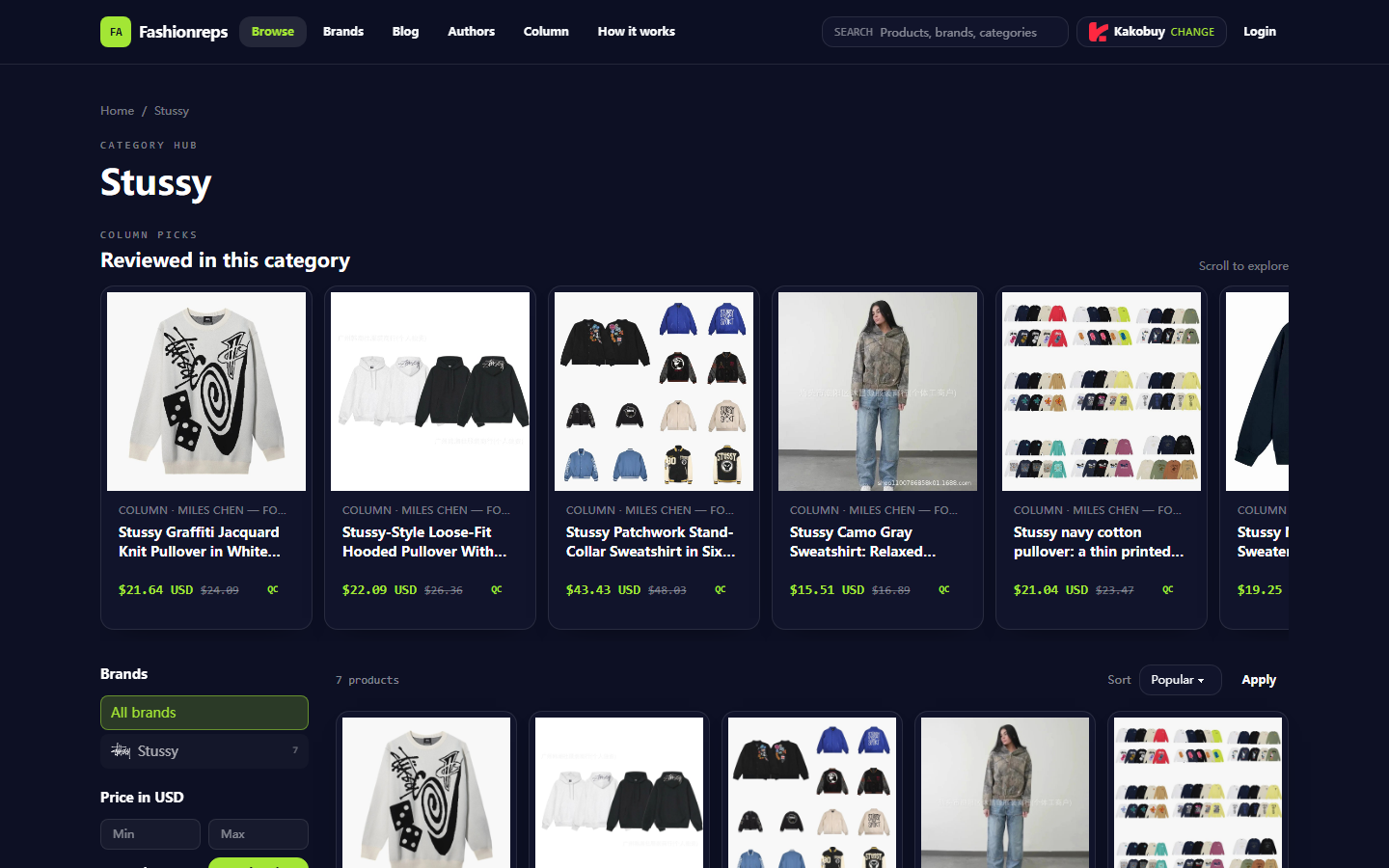
In the currently visible Stussy category page, you can see 7 related product entries, including relaxed hooded pullover styles, gray camouflage pattern hoodies, 430 gsm cotton pullover hoodies, etc. The reference prices shown on the page range from about $15.51 to $43.43, but these are reference prices on the page and should not be directly understood as fixed selling prices or complete landed costs.
The page also shows product titles, some color or structure descriptions, some size ranges, and a QC entry. However, the category page is not a complete specification page for a single item. You still need to open the specific product page to confirm whether the following information is actually visible:
- How chest, shoulder width, body length, and sleeve length are measured.
- Whether the size options correspond item by item to the size chart.
- Fabric composition, weight, or whether it has a fleece lining.
- Structural details such as hood, cuffs, hem, and zipper.
- Whether the current color actually includes gray, and which specific style the gray corresponds to.
- Whether the product images show the front, back, side, and detail areas.
- Whether the page states stock, shipping conditions, and after-sales limitations.
If the page only says "relaxed", "cotton", or "fall/winter style", these words can be used as search clues but are not enough to complete the size judgment. In particular, "cotton" does not equal a fixed weight, and "relaxed" does not mean all parts are scaled up in the same proportion. 🔍
How Fit, Body Length, and Size Chart Correspond
The wearing effect of a hoodie is usually determined by shoulder width, chest circumference, body length, and sleeve length together. Before buying, you should measure a well-fitting hoodie you already own and compare it with the product page data using the same measurement method. Do not treat your body chest circumference directly as the product chest circumference, and do not compare only body length.
You can record in the following order:
- Lay flat a hoodie whose fit you are satisfied with, measure the width from armpit to armpit, then multiply by 2 as a reference for the body chest circumference.
- Measure the width between shoulder seams; if the product uses a drop shoulder design, note that the page's shoulder width definition may be different.
- Measure from the highest point of the shoulder or a unified starting point near the neckline to the hem, and record the body length.
- Measure from the shoulder seam or armhole position to the cuff, and record the sleeve length.
- Compare these data item by item with the product size chart, and leave a margin for measurement error.
| Item to compare | What it helps judge | Risk if information is insufficient |
|---|---|---|
| Chest or body width | Determines layering space and overall looseness | May be too tight or overly bulky |
| Shoulder width and sleeve length | Determines drop shoulder, sleeve bunching, and movement allowance | Shoulder line may droop or cuffs may be too long |
| Body length | Determines coverage when sitting, raising arms, and layering | May look disproportionate or hem may ride up |
| Size measurement instructions | Determines whether page data can be directly compared | May misjudge due to different measurement starting points |
If you are hesitating between two sizes, first confirm whether your goal is a fitted, regular relaxed, or clearly layered look. For pages without a complete size chart, it is not recommended to replace judgment with "size up to be safe", because shoulder width, body length, and sleeve length may increase at the same time, and the result may not fit your body shape.
What Fabric and Detail Information Can Support
The 430 gsm shown on the page only applies to the related styles whose titles explicitly state that value; it cannot be automatically applied to all Stussy hoodies, nor does it prove that the gray style you are interested in has the same structure. If the gray product page does not independently state the weight, record the weight as unconfirmed.
Fabric information can help you estimate thickness and layering direction, but it alone cannot prove warmth. Actual feel is also affected by weave, inner structure, looseness, wind resistance, humidity, and activity level. Without a fleece lining description, do not describe an ordinary cotton hoodie as a thick winter fleece garment.
Before buying, focus on these details:
- Whether the gray is solid, or has camouflage, print, or washed effect.
- Whether the graphics and lettering are embroidery, print, patch, or unstated.
- Whether there are clear close-ups of the drawstrings, pockets, cuffs, and hem.
- Whether the colors in the images are affected by lighting, monitor, or compression.
- Whether there are structural images of the neckline and shoulders to judge.
Images can only be used to discover visible structure; they cannot prove that the feel, weight, wash durability, or actual color is exactly the same. If the product page has no detail images, keep these items as pending verification rather than filling them in with brand impressions. 📷
Adaptability Boundaries for Fall/Winter Smart-Casual Office and Weekend Scenarios
A gray hoodie is usually easy to pair with dark or neutral-colored bottoms, but "easy to pair" does not mean it suits all fall/winter environments. Whether it is suitable for workwear depends on the formality of the workplace, indoor temperature, outer layer space, and whether you need to frequently take off and put on a jacket.
You can divide the usage boundaries like this:
- Indoor smart-casual office: If the office is warm, a regular-weight pullover hoodie may be easier to use; if the page confirms a high-weight or fleece-lined structure, further consider indoor overheating and outer layer layering space.
- Short outdoor trips: The gray hoodie can be used as a mid-layer or casual outer layer, but you cannot judge windproof, waterproof, or warmth performance based only on color and product title.
- Weekend activities: Relaxed fits usually require checking sleeve length, body length, and hem elasticity to avoid excessive bunching during activity or being squeezed by outer clothing.
- Cold weather: Unless the page clearly provides enough thickness, lining, and pairing information, do not treat it alone as a warmth solution for severe cold.
The advantage of gray is that it has a relatively high pairing tolerance, but light gray, dark gray, patterned gray, and washed gray have different visual effects. If you need to precisely match colors with existing pants or jackets, you should wait for clearer real-life product photos or color card information.
How to Interpret Page Images, QC, and User Feedback Separately
Page images, QC photos, and user feedback each solve different problems and cannot replace each other.
Page images are mainly used to confirm the style silhouette, color, and visible design; QC photos are used to check the visible condition of a specific order or specific item before shipping; user feedback can provide usage clues, but you must confirm which style, size, and batch the feedback corresponds to. The currently provided materials do not give verifiable QC records or complete user feedback for a specific gray hoodie, so you cannot assert workmanship, size deviation, or durability based on them.
After receiving QC photos, you can check in the following order:
- Whether the color in the photos matches the ordered color.
- Whether there is obvious asymmetry in the left and right sleeves, shoulder lines, pockets, and graphic positions.
- Whether there is visible damage, stains, loose threads, or severe creases on the fabric surface.
- Whether the size label matches the ordered size.
- Whether there are enough front, back, detail, and measurement photos.
QC photos still only prove what is visible in the photos. You cannot confirm fabric weight, smell, feel, or long-term post-wash performance from a single distant photo. If you find any doubts, raise specific questions within the agent's specified window and save the photos, product page, and communication records. 🧾
When to Hold Off on Ordering Due to Insufficient Information
If any of the following situations occur, holding off on ordering is usually safer than guessing:
- The product page has no usable size chart, or the size chart lacks measurement units and items.
- The product title says gray, but the images show multiple colors and you cannot confirm the corresponding style.
- The page does not explain the fabric structure, and you need to judge whether it is suitable for cold weather.
- A reference price exists, but the actual selling price, stock, or availability on the agent's side is unconfirmed.
- There are only model photos, no product detail photos or follow-up QC plan.
- You cannot confirm the return/exchange window, return costs, and defect handling method.
- You need authenticity verification, brand authorization, or performance guarantee, but the page does not provide corresponding evidence.
Holding off on ordering does not mean denying the product; it means the current evidence is insufficient to support your specific goal. You can first save the product page screenshot, specifications, and question list, then confirm with the agent or seller. Do not submit sensitive information such as order numbers, payment cards, passports, or complete shipping labels in exchange for ordinary product consultation.
Final Action: Decide Whether to Continue After Saving Evidence
It is recommended to first create a simple purchase record, saving the product title, product URL, verification date, color, size, reference price, size chart screenshot, fabric description, and pending questions. Since the system processes on-site links after saving, this article does not manually add links; you can enter the corresponding product from fashion-reps' Stussy category page, and then check real-time information on the external shopping agent side.
The final decision can be handled in three outcomes:
- Information complete, size matches, color and structure clear, and agent confirms stock and policies: you can proceed to the pre-order check.
- Product visible information is basically clear, but there is still a key gap in size, weight, or QC: confirm with the agent or seller first.
- Key specifications, color correspondence, and after-sales conditions are all unclear: hold off on buying, and continue comparing other products with complete information.
The current materials do not have enough evidence to calculate how much money can be saved by combining or splitting packages, so do not fabricate specific savings figures. In actual comparison, calculate the product amount, agent service fee, domestic shipping, international shipping, possible taxes, and return/exchange costs together. Combining packages may reduce repeated first-weight or handling costs, but may also increase package value, volumetric weight, and single loss risk; splitting packages may increase fixed costs, but is more suitable in terms of route restrictions or risk diversification.
This verification method is suitable for buyers who value size accuracy, fall/winter layering, and evidence retention. It is not recommended to order based only on the words "stussy", "gray", "relaxed", nor to treat the category page reference price as the final cost. First save the visible evidence, then confirm the missing information, and finally decide whether to continue based on your own smart-casual office, weekend, or cold weather needs. This is currently a safer buying path. ✅
Article Image
Continue reading