From the blog
represent Joggers: Compare QC and Returns
Illustration of the fashion-reps Represent category page and shopping agent entry points. Page information should be verified against what is actually visible w...
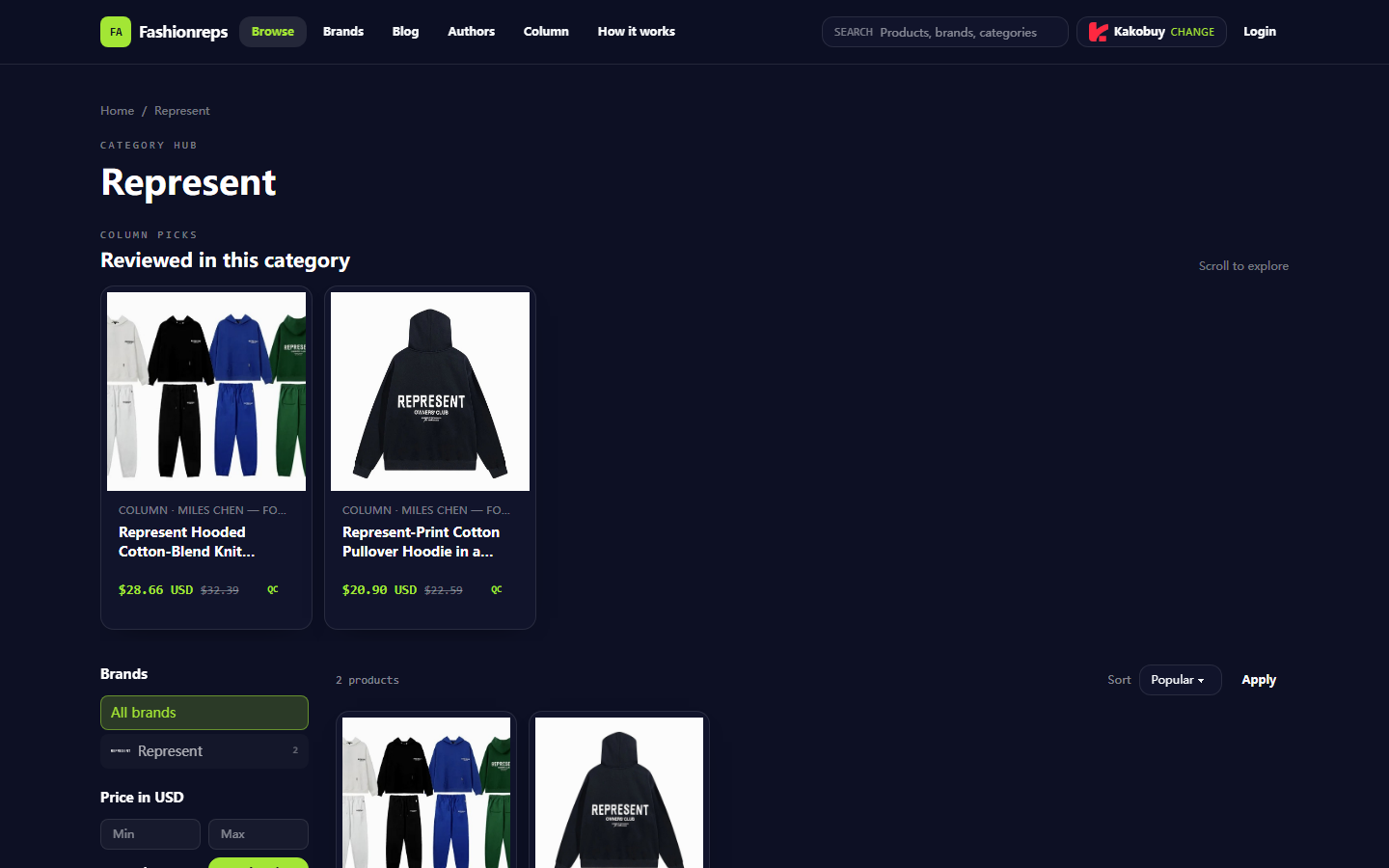
Illustration of the fashion-reps Represent category page and shopping agent entry points. Page information should be verified against what is actually visible when opened.
This article addresses a specific decision: you've seen represent joggers-related products on fashion-reps and are about to submit them to a shopping agent platform. Before doing so, how do you verify the pants style, sizing, colors, QC photos, warehouse status, and return/exchange paths to avoid ordering based solely on the product title or a single image?
After reading, you should be able to do three things: record verifiable information about candidate products; determine which questions must be backed by evidence before submitting the link; and decide whether to continue comparing, contact the platform, or hold off on submitting when QC or warehouse information is insufficient.
This article does not apply to situations requiring confirmation of real-time inventory, current shipping costs, taxes, specific return amounts, or the latest policies of a particular agent. Such information is highly volatile and must be re-verified on the corresponding platform's page before submitting an order, noting the date, destination country, and currency. 🧾
What Decision Does This represent Joggers Platform Comparison Solve?
The core is not determining which platform is "best," but whether the current evidence is sufficient to support the next step.
fashion-reps provides product discovery and purchase entry information. The page states that product buttons lead to the selected shopping agent, and that orders, payments, and shipping are handled by the agent's website. Therefore, the product descriptions, reference prices, and category information seen on fashion-reps do not automatically prove that the agent platform has confirmed inventory, sizing, QC standards, or return eligibility.
The shopping agent page handles another layer of tasks: receiving product links or specification notes, creating orders, displaying order status, and providing warehouse and QC information once the item arrives. Specific procedures, additional photo rules, return windows, and customer service handling must be based on the actual agent page and its current rules.
The editorial standard is simple: if a conclusion cannot be supported by visible page information, order status, QC records, or official rules, it should be marked as "to be verified," not written as a platform advantage or product fact. 🔎
Comparison Scope and Evidence Boundaries: What Product Pages, QC Pages, and Official Rules Prove
This comparison revolves around one purchase decision: whether to submit represent joggers found on fashion-reps to a shopping agent and establish sufficient QC and return/exchange evidence before submitting.
| Item to Verify | Conclusions It Can Support | Conclusions It Cannot Directly Support |
|---|---|---|
| fashion-reps product page | Product name, category, visible reference info, purchase agent entry | Real-time inventory, actual shipment, final material feel, agent has accepted order |
| Agent submission page | Whether link is accepted, whether specs notes are saved, whether order is created | QC will pass, seller definitely has stock, returns will definitely be free |
| QC page or warehouse record | Visible condition in uploaded photos, recorded measurements or defects | Areas not in photos are flawless, physical touch, final fit |
| Agent official rules | Fees, time limits, return conditions, and restrictions explicitly stated on page | Current order necessarily complies, or customer service will approve exceptions |
| Customer service reply | Written response for a specific issue and applicable conditions | Applies to all products, all warehouses, or all orders |
If different platforms lack evidence at the same level, the comparison result can only be stated as "different degrees of evidence completeness," not converted into a ranking. In particular, do not interpret one platform having public rules and another temporarily lacking a page as the former being more reliable.
First Verify Style, Sizing, Colors, and Page Status on fashionreps
After opening the product page, record what the page displays at that moment; do not just save the title. It's recommended to create a candidate record line that includes at least:
- Product name and page URL
- Product category
- Pants style or set relationship shown on page
- Visible color, size, or specification options
- Whether the page is still accessible
- Whether the page displays clear product information, not blank, tabbed, or dead entry
- Displayed reference price, currency, and verification date
- Selected shopping agent name
A representative title cannot replace spec verification. For example, the page title might describe a set of top and pants, or only highlight the series name. Before submitting, confirm whether you actually need a single pair of joggers or a set including a top; also confirm whether size options come from the product page, not inferred from a common size chart.
Colors also need to be recorded item by item. Black, gray, washed, or printed versions may correspond to different product links, sellers, and stock statuses. If the page only shows the product name without selectable colors or sizes, mark these fields as "no page evidence seen," and do not fill them in yourself.
Page status is equally important. Being able to open the page and see the product name does not mean the product is still purchasable; if there is a redirect, empty page, dead button, or only category navigation, hold off on submitting and first confirm the new valid entry. 📌
Record Link Submission, Spec Notes, and Order Status on Candidate Agent Pages
When submitting the link, it's recommended to condense the candidate product information into a reviewable note: product page, target color, target size, quantity, and key questions to be confirmed by the agent. The note should describe facts and requests, not promises that cannot be acted upon like "please guarantee authenticity" or "please guarantee no defects."
You can check in the following order:
- After pasting the product link, confirm that the system's recognized product name matches the original page.
- Check whether color, size, quantity, and other fields are parsed correctly.
- If automatic parsing is missing fields, supplement with notes and keep the original page display content.
- After submission, record the order or inquiry number; do not rely solely on browser history.
- Check whether the status is pending confirmation, pending payment, purchasing, in warehouse, or another clear status.
- If the page returns an error, the status remains unchanged for a long time, or specs are overwritten, first save evidence and ask customer service; do not resubmit the same link repeatedly.
Repeated submissions create two risks: one is generating duplicate orders or inquiries, and the other is making it difficult for subsequent customer service to determine which specification is the valid request. Only create a new request when it is confirmed that the original request did not generate a record, or when the platform explicitly requires resubmission.
If one agent page can display spec parsing and order status while another candidate platform lacks the same information, the current conclusion can only be that the former provides more visible evidence at this step; it still cannot be judged that its final QC or after-sales will definitely be better. ⚖️
Compare QC Photo Access, Additional Photo Conditions, and Visible Defect Recording Methods
The goal of QC is to help you spot visible issues before the package leaves the warehouse, not to prove that the product is flawless in every aspect. When verifying, distinguish between "whether there are QC photos" and "whether the photos are sufficient to support a decision."
Prioritize checking the following:
- Whether QC photos can be accessed directly from the current order or warehouse page
- Whether photos correspond to the correct order, product, color, and size
- Whether front, back, tags, size label, main print, and obvious seam areas are visible
- Whether photos are clear, without obstruction, underexposure, or insufficient angles
- Whether the page provides an entry for additional photos, measurements, or further checks
- Whether submitting a defect description creates a trackable ticket or status record
When observing photos, describe only visible facts. For example, you can write "there is a light-colored area near the right cuff that needs to be zoomed in for confirmation," not "the fabric is damaged," unless the photos and platform records sufficiently support that judgment. Photos cannot prove hand feel, thickness, stretch, or wearing comfort; these should remain unverified.
If key areas are missing from photos, first submit specific additional photo requests: area, angle, whether a size label or measuring tape reference is needed, and the issue you want to confirm. Do not submit vague requests like "please take clearer photos," as customer service or warehouse staff may not know what you need.
Also record the potential costs, time limits, and restrictions of additional photo conditions. If the rules do not clearly state whether additional photos are charged, or whether they affect the return window, mark as "to be confirmed," and do not assume they are free or unlimited. 🧵
Compare Warehouse Receiving, Packaging, Return/Exchange Conditions, and Customer Support Paths
Warehouse receiving status is a signal that the item has arrived and entered the next processing step, but it does not mean quality confirmation is complete. Record separately:
- Whether "in warehouse" is displayed
- Whether received quantity matches order quantity
- Whether QC photos have been generated
- Whether there is weight, dimensions, or packaging information
- Whether there are pending exceptions
- Whether the return/exchange application entry is on the order page, warehouse page, or customer service channel
Packaging and consolidation cannot be calculated without specific order details. Consolidation may reduce repeated first weight or some handling costs, but may also increase volumetric weight, single package value, or risk of loss in one shipment; splitting may increase fixed fees, but may be suitable for route restrictions, product category restrictions, or reducing single-package risk. Without current order weight, volume, destination country, and quotes, you cannot provide savings amounts or recommendations.
The return/exchange path must confirm at least four conditions: when the application deadline starts; which reasons are accepted; whether photo or video evidence is required; and who bears the costs of return shipping, warehousing, and reshipping. Seller return policies, agent warehouse rules, and international shipping after-sales rules may be three sets of different rules and cannot be conflated into one "return policy."
When contacting customer service, send the order number, product number, specific issue, and necessary screenshots. Do not disclose order passwords, full payment card information, passports, complete shipping labels, or other irrelevant personal data. If screenshots contain sensitive information beyond address, phone number, or order number, cover them first, but do not obscure key areas needed to judge product or logistics status.
If customer service only says "please wait" without explaining the applicable status, expected next step, or materials to supplement, keep the "to be verified" status. Without written rules or order-level responses, do not treat verbal hints from customer service as a definite return/exchange promise. 🔐
How to Build a Verification Table When Information Is Missing Without Fabricating Platform Strengths or Weaknesses
Insufficient information does not mean you cannot act. Use a brief verification table to separate "confirmed," "needs inquiry," and "hold submission."
| Field | Current Recording Method | Next Action |
|---|---|---|
| Style and set relationship | Page title or description explicit / unclear | Return to product page to confirm single item or set |
| Color and size | Page shows / no options seen | Screenshot and ask agent if specifiable |
| Link status | Accessible and complete info / dead or empty | Pause repeated submissions, find valid page |
| QC entry | Displayed / not found | Check order help or ask customer service |
| Additional photos and measurements | Rules clear / not stated | Ask about fees, time limits, and inspectable areas |
| Return/exchange conditions | Order-level rules available / only general description | Get written applicable conditions before paying |
| Warehouse status | Clear status like in warehouse, pending QC / no status | Save request number and wait or contact customer service |
The value of this table is to prevent filling gaps with imagination. For example, "QC entry not found" does not mean "platform does not provide QC"; "page has reference price" does not mean "final purchase price is this number"; "return policy exists" does not mean the current item necessarily meets return conditions.
When comparing across platforms, use the same fields, same product link, same destination country, and same time point as much as possible. If one platform can verify order-level rules and another only has a general overview page, note the different evidence levels and limit the conclusion to "current verifiability." Do not fabricate prices, timeframes, ratings, or success rates without sources just to produce a winner.
Next Steps: Continue Comparing, Gather More Evidence, or Hold Off on Submitting Link
You can decide based on three outcomes:
- Continue comparing: product page accessible, style, color, and size basically clear, candidate agent can record link and specs, and next QC or after-sales entry is locatable.
- Gather more evidence: product name clear, but specs, QC additional photos, warehouse status, or return conditions still missing one item. First obtain page screenshots, order-level responses, or official rules before deciding
Continue reading