From the blog
Manchester City Jersey Bundle Cost Check
Deciding whether to combine or split Manchester City jerseys for shipping isn't about comparing whichever shipping fee looks cheaper first. Instead, put the pro...
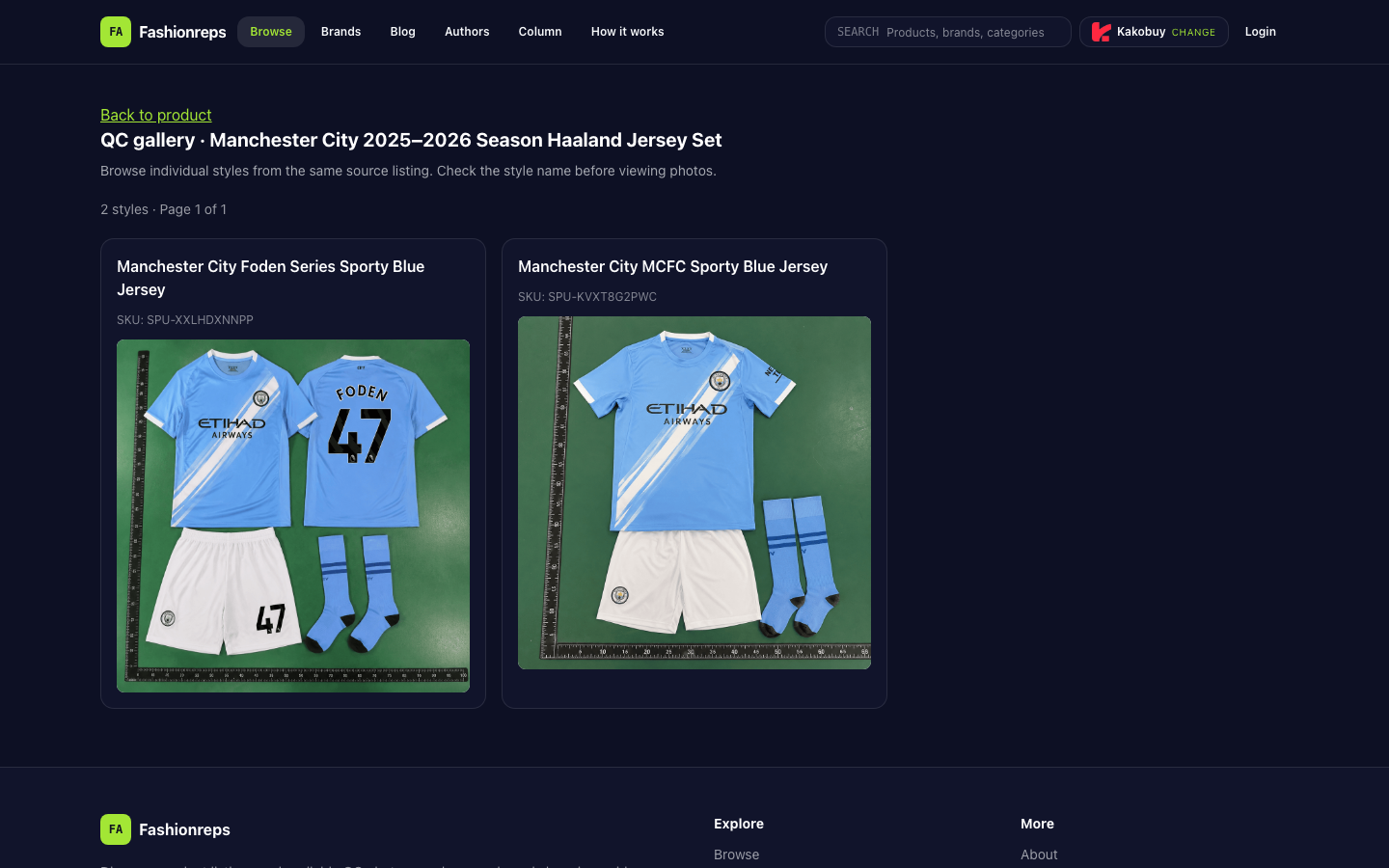
Deciding whether to combine or split Manchester City jerseys for shipping isn't about comparing whichever shipping fee looks cheaper first. Instead, put the product, packaging, warehousing, service fees, and chargeable weight into one record, then double-check with the final settlement page. The current QC page available for verification lists two styles: Manchester City Foden Series Sporty Blue Jersey and Manchester City MCFC Sporty Blue Jersey. The page data does not provide the product prices, discounts, packaging status, service fees, storage fees, actual weight, chargeable weight, route rates, or taxes needed for this article, so savings cannot be calculated from it, nor can it be determined which option is definitely cheaper.
First Confirm You're Comparing the Same Batch of Products
Before deciding to combine orders, register each jersey separately. The style name, player or number version, size, and quantity must match the cart, order, or warehouse records. The current QC data can only confirm the two style names above; it cannot replace the product page's confirmation of specific sizes, number versions, inventory, and transaction prices.
Recommended items to record at minimum:
- Style name, and whether Foden version or MCFC version
- Player, number, or printing version; do not fill in on your own without page evidence
- Size and quantity
- Product page amount, discount amount, and actual paid amount
- Order number or warehouse package number
- Whether it has been received and passed QC
- Whether there are out-of-stock, replacement, or refund records
If styles, sizes, or order statuses within the same batch have not been confirmed, record them separately first. Otherwise, later when merging different orders, it's easy to double-count product prices, service fees, or refund amounts.
Record Combined and Split Orders Separately
Do not keep just one total. At minimum, create a per-item or split-order record, then a combined-order record, and mark which data is confirmed and which still needs verification.
| Cost Item | Per-item or split order check | Combined order check | Current data confirmable? |
|---|---|---|---|
| Product price & discount | Page amount, discount, and actual paid for each jersey | Total product amount for merged order or package | Cannot confirm |
| Packaging | Whether original packaging is kept, removed, and associated operation fees | Final packaging status of merged package | Cannot confirm |
| Storage | Storage start conditions and amount for each package | Whether additional storage or handling fees occur before/after merge | Cannot confirm |
| Payment fees & service fees | Order payment fees, purchasing fees, or handling fees | Merge operation, repacking, or value-added service fees | Cannot confirm |
| Weight | Actual weight and chargeable weight | Actual weight and chargeable weight after merge | Cannot confirm |
| International shipping | Selected route, chargeable bracket, and surcharges | Route, chargeable bracket, and surcharges after merge | Cannot confirm |
| Taxes | Applicable conditions, prepaid or collect fields | Merged declaration info and possible tax fields | Cannot confirm |
| Exchange rate | Exchange rate and currency used at payment | Exchange rate and currency used at combined payment/settlement | Cannot confirm |
"Cannot confirm" here does not mean the fees don't exist, but that current evidence provides no specific values or applicable conditions. Without these fields, post-merge shipping changes cannot be treated as realized savings.
Packaging Status Is a Key Checkpoint Before Combining
First, check the warehouse page or customer service to confirm whether packaging is still retained and whether removing, compressing, or repacking incurs fees. Identical product prices for jerseys do not mean keeping or removing packaging yields the same chargeable weight; however, without actual weighing and rate data, you cannot assume unpacking always reduces shipping costs.
Save the following evidence during verification:
- Current packaging photos or warehouse status for each package.
- Whether merging is allowed and whether reweighing occurs after merge.
- Fee fields for removing original packaging, reinforcing, or repacking.
- Actual weight, volumetric weight, and final chargeable weight after merge.
- Whether fees are charged per order, per package, by weight bracket, or by service item.
If you can only see product QC images and not package status or weighing results, you can only verify product identity, not packaging costs.
Calculate Two Sets of Total Costs Using the Same Standard
Use the structure below to fill in per-item or split-order plans and the combined plan:
Total cost = actual product payment + payment fees + service fees + packaging or handling fees + storage fees + international shipping + taxes
If exchange rates affect any item, also record currency, conversion time, and the exchange rate shown on the settlement page. Do not directly add amounts from different times, currencies, or orders.
| Plan | Settlement evidence required | Possible conclusions | Conclusions not directly possible |
|---|---|---|---|
| Split orders | Actual weight, chargeable weight, route, service fees, packaging, and final settlement amount for each package | Can confirm actual total cost of split orders | Cannot infer combined is definitely more expensive |
| Combined order | Reweighed result after merge, packaging handling fees, route, taxes, and final settlement amount | Can confirm actual total cost of combined | Cannot infer how much is saved based only on product quantity |
Only when both plans use the same currency and expense standard is the difference comparable. If any item still shows "to be confirmed," mark the result as pending verification, not fill in estimated values.
Pre-Payment Review Sequence
Step one: Return to the product page or order page to verify names, sizes, quantities, and current availability of the two styles. The QC page proves the page once listed the styles, but cannot alone prove current inventory, price, or shipping fees are still valid.
Step two: Check product amounts, discounts, and payment currency in the cart or purchasing order. If discount conditions are not clearly stated on the current page, do not include the discount in expected total cost.
Step three: Confirm with the warehouse about packaging retention, removal, reinforcement, and merge options, and request to see corresponding fee fields or formal quotes.
Step four: Check route, chargeable weight, surcharges, and tax fields separately on the official shipping calculator, cart, and final settlement page. Calculator results are only estimates; conditions on the final settlement page should be recorded pre-payment.
Step five: Compare the combined and split order records. If the combined plan lacks reweighing, packaging handling fees, or tax information, pause the decision until these fields are completed.
Sound Judgment Based on Current Evidence
What can be confirmed now is that the designated QC page shows two related Manchester City styles; what cannot be confirmed are product prices, packaging status, service fees, storage fees, actual weight, chargeable weight, route rates, taxes, and exchange rates. Therefore, no conclusions like "combining saves more," "splitting is safer," or specific savings amounts should be published at this stage.
The sounder approach is to first complete cost records for both plans, then rely on the final settlement page. If the merchant or warehouse cannot provide post-merge weight, packaging, and service fee details, retain this uncertainty and do not convert missing data into recommendations.
Continue reading