From the blog
Maison Margiela Low-Top QC: Upper, Sole, Size Check
What This Maison Margiela Low-Top Shoe QC Check Aims to Solve This QC guide addresses a specific problem: when a product detail page offers a View QC Photos ent...
What This Maison Margiela Low-Top Shoe QC Check Aims to Solve
This QC guide addresses a specific problem: when a product detail page offers a View QC Photos entrance, how to determine whether the images truly correspond to the Maison Margiela low-top shoes you intend to buy, and which visible information is sufficient to support requesting additional photos, consulting, pausing the purchase, or submitting an after-sales request.
After reading, you should be able to accomplish three things: confirm the product identity in the QC photos, record visible facts item by item for the upper, sole, and size evidence, and turn any unverifiable parts into clear decisions to request more photos or pause. This article is not applicable to using images from other products, category pages, or brand pages as QC evidence for these shoes, nor is it applicable to judging authenticity, comfort, durability, or final quality solely from photos.
Verification date: 2026-10-21. Prices, inventory, sizes, service fees, international shipping, taxes, return/exchange windows, and image status should all be based on the product detail page and shopping agent page at the time of your order. 👟
Correct Path from Product Detail Page to View QC Photos
The correct sequence is to first open the target product detail page, then click the button or entrance named View QC Photos within the page, and confirm that you have entered the QC gallery for the same product. Do not guess the QC address directly, and do not substitute search results, product main images, brand pages, category pages, or other product galleries.
After entering the gallery, first record the following information:
- Whether the product name clearly states Maison Margiela low-top shoes or the corresponding specific shoe model name.
- Whether the color, size, style number, or seller information on the product page matches the order selection.
- Whether the images come from the QC gallery of this product, not from recommended products or other styles of the same brand.
- Whether you can see photos of the upper, toe, collar, sole, insole, shoe tag, and size.
- Whether the images are clear enough to support item-by-item observation, rather than being only distant shots or partially obscured.
The evidence record provided this time needs special distinction: its source path has a QC label, but the visible product summary clearly describes a Maison Margiela multicolor printed T-shirt, and the page title is also from the T-shirt series, not low-top shoes. Therefore, this image cannot be used as evidence for the upper, sole, size, or defects of Maison Margiela low-top shoes. It can be used to illustrate "must first verify product identity" but cannot be used to prove the condition of the shoes. 🧾
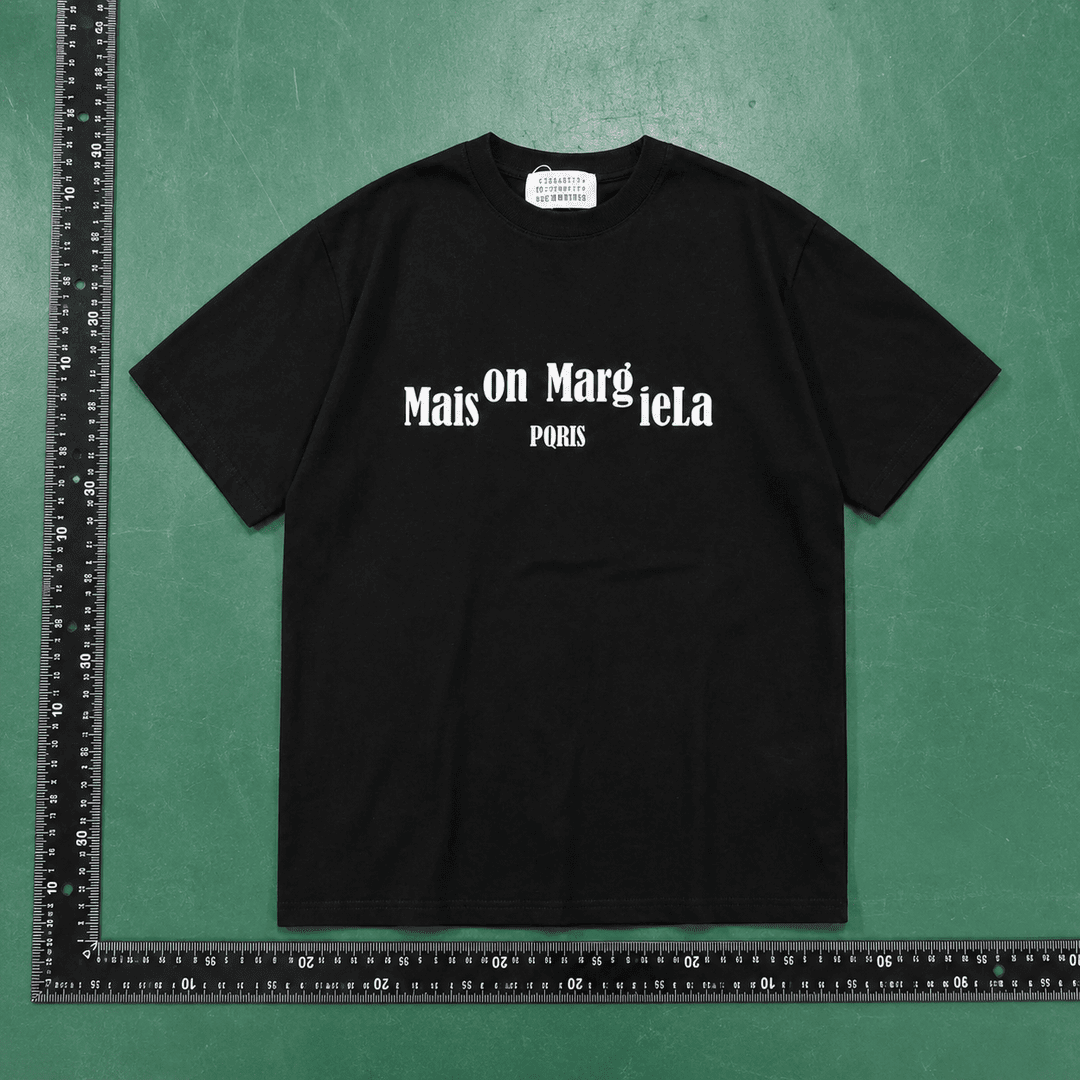
This image corresponds to the Maison Margiela multicolor printed T-shirt page in the provided QC evidence record; because the product category does not match low-top shoes, this image is not used to judge the upper, sole, size, or shoe body defects.
If you do not see a QC gallery matching the selected color and size on the correct low-top shoe detail page, you should pause judgment and request actual QC photos corresponding to that order from the seller or shopping agent.
What Visible Evidence to Record for Upper, Toe, and Collar
After obtaining QC photos that truly belong to the target low-top shoes, it is recommended to view them in a fixed order, not just look at one clearest frontal photo.
First look at the overall upper:
- Whether the left and right shoe colors are consistent, and whether there is obvious color difference or partial uneven dyeing.
- Whether the toe curves are similar on left and right, and whether there is obvious collapse, skew, or indentation.
- Whether the stitching lines on the upper are continuous, and whether the edges show skipped stitches, broken threads, loose threads, or abnormal density.
- Whether the collar height, opening shape, and heel structure are similar on left and right.
- Whether the positions of prints, embossing, or logos match the style shown on the product detail page.
- Whether lace holes, tongue, laces, and collar lining have obvious missing parts, looseness, or stains.
Then look at partial details. Only content directly visible in the images should be written as facts, such as "a light-colored spot mark is visible near the toe of the right shoe" or "a section of loose thread is visible near the stitching on the outer side of the left shoe." Do not write judgments like "looks like real leather," "looks like high-quality workmanship," or "should be comfortable to wear" as evidence, because these judgments cannot be directly proven by ordinary QC photos.
Prints, embossing, and brand logos should be recorded separately for position, clarity, and obstruction. What the photos can prove is whether the pattern is visible, and whether there is obvious misalignment, scratching, or gaps; they cannot prove authenticity from pattern appearance alone, nor can they equate clear brand logos with a guarantee of authenticity. 🔍
How to Check Sole Tread, Edges, and Left-Right Symmetry Item by Item
At least three observation angles are needed for the sole: front, side, and bottom. With only a side view, you cannot infer the wear of the entire sole, tread integrity, or bottom stains.
Record in the following order:
- Check whether the sole tread is complete and whether there are obvious gaps, crush marks, foreign objects, or abnormal adhered substances.
- Check the connection between the midsole and upper, focusing on excess glue, openings, lifting edges, uneven edges, and partial discoloration.
- Compare the sole thickness, heel height, edge curvature, and tread direction of the left and right shoes.
- Check whether there are obvious indentations on the forefoot and heel of the sole; if the photo is just a staged shot, do not interpret indentations directly as wear from use.
- Check whether the sole label, printed text, or pattern is obstructed, reflective, or cropped; if unclear, record as "cannot confirm."
Left-right symmetry does not require the two shoes to be identical copies, but rather checks for obvious differences that would affect wearing or structural judgment. For example, if one toe is clearly biased to one side, the collar heights of the two shoes differ significantly, or there is continuous opening on one side of the midsole, it is worth requesting additional photos or consulting.
| Visible Condition | Safer Handling |
|---|---|
| Only one shoe or only distant view | Request complete, multi-angle photos of both left and right shoes |
| Sole edge obscured by shadow | Request side photos with natural light or fill light |
| Excess glue visible but cannot determine if it affects bonding | Ask whether that condition is acceptable, and pause purchase if necessary |
| Obvious structural difference between left and right shoes | Submit clearly marked images within the after-sales window and wait for handling opinion |
These handling suggestions only target visible evidence from photos and do not constitute a guarantee of seller responsibility, platform policy, or after-sales outcome.
How to Cross-Check Size Photos Separately from Product Page Size Information
The size chart on the product page and the QC size photos are two types of evidence and cannot replace each other.
The product page size information is usually used to confirm available sizes, the indicated foot length range, measurement method, and size recommendations. The QC size photos are used to confirm whether the actual photographed object is the size you selected, and whether the measurement method in the photos is clear enough. If there is no size photo, the numbers on the product page cannot be treated as the actual measured result for this pair of shoes.
When cross-checking, record:
- Whether the size selected in the order and the size shown on the product page are consistent.
- Whether the size markers in the photos are clear, and whether it can be confirmed that both shoes belong to the same size.
- Whether the zero point of the ruler is aligned, whether the foot length measurement direction is complete, and whether the insole length and the outer sole length are confused.
- Whether the photo shows the unit; centimeters and millimeters cannot be mixed.
- Whether the measurement photos have obvious tilt, bending, or obstruction, causing the reading to be only a rough reference.
The insole length, insole length, and outer sole length are not the same indicator. If your foot type, thick socks, or wearing habits require more space, you should ask the seller for the applicable measurement standard, and provide your foot length, foot width, and usual shoe size to the shopping agent or seller for verification. Do not infer size solely from the brand name, and do not directly apply size experience from other shoe models to this model.
How to Annotate Creases, Stains, Obstructions, and Insufficient Photos
Annotations should include location, phenomenon, clarity, and next action, avoiding simply writing "has problem" or "looks okay." For example:
- Outer side of left toe: a shallow crease visible; photo clear; request confirmation whether it can be improved through arrangement.
- Edge of right heel: dark spot marks present; cannot confirm whether it is stain, shadow, or material texture; request close-up additional photo.
- Forefoot of both soles: bottom obstructed by shooting angle; cannot judge tread integrity; request bottom photo.
- Inside of tongue: tag obstructed by laces; cannot confirm size or style information; request close-up after moving laces aside.
A three-level recording method can be used:
- Visible: photo clear, position and phenomenon can be directly described.
- Partially visible: local area can be seen, but cannot judge extent, severity, or cause.
- Cannot confirm: no photo, severe reflection, shadow obstruction, insufficient resolution, or product identity mismatch.
"Cannot confirm" does not mean "no problem." If key areas cannot be confirmed, the action should be written as requesting more photos, consulting, or pausing, not directly passing.
Which Observations Only Support Requesting More Photos, Consulting, or Pausing Purchase
The following situations usually can only support further verification and cannot directly lead to conclusions about authenticity or quality:
- Brand logo is clear: only shows the logo is visible in the photo, cannot prove authenticity.
- Upper color is consistent: only shows no obvious color difference in the current photo, cannot prove the actual item is completely consistent under different lighting.
- No obvious stains on sole: only shows no obvious stains from the current angle, cannot prove all areas are clean.
- Size number matches order selection: only shows the markings appear consistent, cannot prove the actual inner length of the shoe fits your foot.
- No obvious glue separation: only shows no obvious separation in the photo, cannot guarantee the condition after shipping or wearing.
A simple decision logic can be used: if product identity, order size, and key areas are all clear, and there are no obvious issues requiring handling, you can continue to check price, service fee, shipping, and after-sales window; if only partial areas are unclear, first request additional photos or consult; if product identity does not match, key areas remain without photos, or obvious structural issues that may affect wearing are found, you should pause the purchase or submit a request within the applicable after-sales period. 📌
The image provided this time is a case of product identity mismatch: it cannot support QC pass for Maison Margiela low-top shoes. The next step should be to reopen the target low-top shoe detail page, click the View QC Photos within that page, and confirm that the gallery title, color, size, and image content all correspond to the same product.
Final Action: Save Maison Margiela QC Evidence and Make a Handling Decision
When saving evidence, it is recommended to simultaneously keep screenshots of the product detail page, the View QC Photos entrance, original QC images or files allowed for saving by the platform, order selection information, and verification date. Personal address, phone number, order number, payment information, and complete waybill should not be made public; if sharing screenshots is necessary, these details should be obscured first.
The final record can be organized in the following format:
- Product identity: Whether it clearly corresponds to the target Maison Margiela low-top shoes.
- Order selection: Whether color, size, and style are consistent with the image markings.
- Upper: Visible condition of color, toe, collar, stitching, prints, and hardware.
- Sole: Visible condition of tread, edges, connections, and left-right symmetry.
- Size: Record product page size information and QC size photos separately.
- Uncertain items: Specific reasons for requesting more photos, consulting, or pausing purchase.
- Time conditions: Verification date for price, inventory, shipping, taxes, and after-sales window.
If the correct gallery shows completeness and no obvious issues requiring handling, still verify the fees, routes, restrictions, and after-sales rules displayed by the shopping agent before proceeding. If key evidence is missing, do not use images from other Maison Margiela products to fill the evidence, and do not infer authenticity or quality just because the images look neat.
In the evidence provided this time, the image corresponds to a Maison Margiela multicolor printed T-shirt, not low-top shoes. Therefore, the safest decision is to defer passing QC judgment on the low-top shoes until the genuine QC gallery corresponding to the target shoe model is obtained.
Article Image
Continue reading