From the blog
Louis Vuitton Trainer Low Sizing: Oversize and Color Check
If you're planning to order the Louis Vuitton Trainer Low remotely, the most important thing to confirm isn't "always size down one," but whether the target col...
If you're planning to order the Louis Vuitton Trainer Low remotely, the most important thing to confirm isn't "always size down one," but whether the target color, version, and your foot shape align. The current page lists sizes 35–45, and the shoe is a low-top basketball sneaker; user feedback on fit focuses on running large and feeling stiff at first, but the amount of extra room and pressure points vary by colorway.
First, confirm the specific variant you're looking at
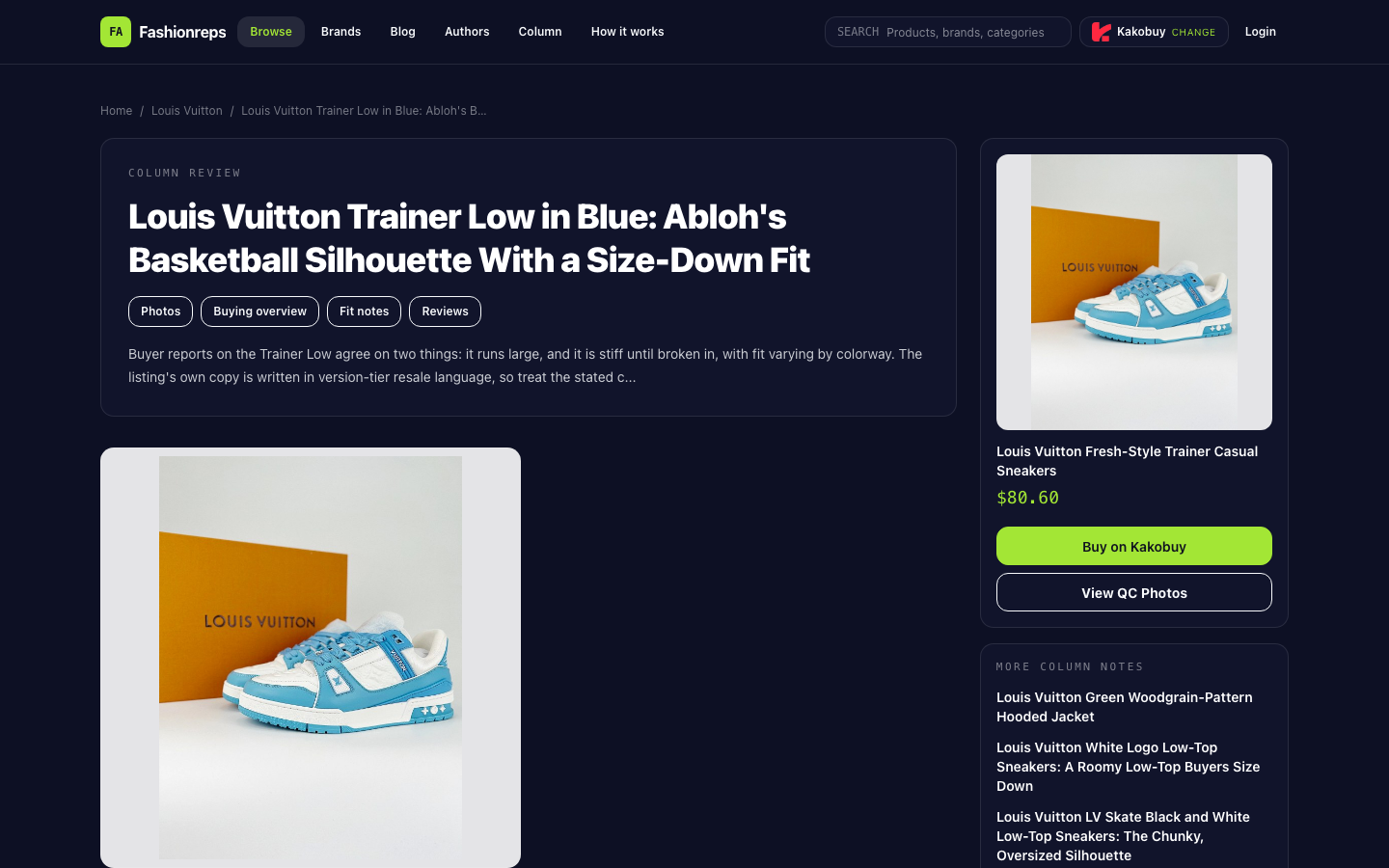
The page mainly showcases the blue and white colorway, which users find easy to style with jeans, joggers, and suit trousers. But that only speaks to its styling versatility; it doesn't mean other colors have the same fit.
Before ordering, note down the following:
- Exact color, including the main upper color, side accents, and sole color.
- Men's or women's designation, and any version info listed on the page.
- Whether your target size is within the listed 35–45 range.
- Whether the seller can provide insole length, upper width, and current QC photos for that specific color and size.
Record color differences and version differences separately. User feedback mentions that the white and black colorway sometimes runs looser than the green one; different versions may have different materials and padding that change the actual space. You can't confirm these differences from just the main product image or a size chart.
Oversize feedback can be a reference, but not a rule
Current feedback generally supports that the Trainer Low runs large: some suggest sizing down half a size, while others have actually chosen a much smaller labeled size. For example, one buyer who wears US 11 chose LV 9; another who wears Nike 42.5–43 found a 40 still had room. These are individual experiences, not a conversion table that applies to all colors, versions, and foot shapes.
The page also notes the opposite: a user with narrow feet who usually wears 36 had no obvious extra space, and insole and lining thickness may vary by colorway. So readers with wide feet, high insteps, or who need thick socks should not rely solely on "runs large"; narrow-footed readers should not assume they must drastically size down.
Treat the feedback as a starting point: first check if you need a half size or smaller, then verify with actual measurements of the target variant, rather than blindly copying someone else's size.
Build your own judgment based on foot shape
Start by measuring a low-top sneaker that currently fits you well. Remove the insole and measure its length and widest width; if the insole isn't removable, measure the interior space from front to back, and note if your toes touch the end or your forefoot feels squeezed.
Then measure the length and forefoot width of both feet, using the larger foot as the standard. Note whether you typically wear thin socks, thick socks, or no socks, and your preference for toe room. The Trainer Low feedback includes cases of running large as well as side pressure and stiffness, so having the right length doesn't guarantee the forefoot will fit.
| Your situation | Key things to check | Safer decision |
|---|---|---|
| Narrow feet, usually have extra room in sneakers | Insole length of the target color and heel slippage | Compare a half size or smaller first, and make sure there's no obvious heel slip |
| Standard feet, have a well-fitting shoe to measure | Existing insole length and forefoot width vs. target variant data | Prioritize actual measurements; don't rely solely on others' size conversions |
| Wide feet, high instep, or wear thick socks | Upper width, lace area, and forefoot pressure | Don't blindly size down drastically to eliminate heel room; pause if necessary |
| Sensitive to stiff soles or stuffy shoes | Internal structure, ventilation, and insole thickness | If you can't handle a break-in period, order with caution |
Treat "runs large" and "stiff" separately
Running large mainly affects heel stability and slippage while walking; stiffness affects bending, forefoot pressure, and break-in time. Current buyers describe the Trainer Low as stiff at first, some say the sole feels like a brick, and others improved comfort by replacing the insole. The page also mentions the upper lacks ventilation holes, and some users find their feet get hot.
Therefore, sizing down only addresses part of the space issue; it doesn't solve stiff soles, stuffiness, or side pressure. If you need a sneaker that's soft and breathable right out of the box, these feedback points are limitations to consider.
Ask the seller for three pieces of evidence before ordering
When contacting the seller, try to narrow your questions to the specific color and size, not just "is it true to size?" Request:
- The insole length of the target size, with the measurement start and end points specified.
- The upper width at the widest part of the forefoot, preferably indicating whether external decorations are included.
- QC photos for the target color and size, focusing on the toe leather, side pressure areas, sole gluing, and left-right differences.
After receiving the photos, record the seller's data alongside your own measurements from a well-fitting shoe. If the seller only provides a generic size chart, you can't confirm the actual internal dimensions; if the QC photos are not of the target color or size, they don't prove your order will be in the same condition.
When to proceed and when to pause
You can consider proceeding if: the target color is confirmed, the seller can provide actual measurements and QC photos for that size, the data is close to your well-fitting shoe, and you accept a certain break-in period. Also, confirm the return/exchange policy before paying.
You should confirm the return/exchange policy before paying if: you're hesitating between a half size down and a smaller size, or there are conflicting feedback for the same color. Especially if you have wide feet, a high instep, can't tolerate heel slip, or can't accept forefoot pressure, don't just solve it by "sizing down one."
Consider pausing the purchase if: the seller cannot provide evidence for the target variant, color and version info are mixed, QC photos are missing, or the return/exchange policy is unclear. The risk of remote ordering isn't just about the size label, but also whether the actual variant matches the reference feedback.
The reference price shown on the page is $80.60. Final product price, service fees, and international shipping must be confirmed with the shopping agent platform; these cost details do not, in turn, prove anything about size or product condition.
Continue reading