From the blog
Hermes Scarf Buying: Size, Pattern, Wear Checks
Introduction When viewing hermes-related items on fashion-reps, the most important thing before purchasing is not to judge whether the pattern looks good, but t...
Introduction
When viewing hermes-related items on fashion-reps, the most important thing before purchasing is not to judge whether the pattern looks good, but to confirm whether the page information is sufficient to support your actual choice: whether the size is clear, whether the pattern position matches the images, whether the thickness is suitable for the intended wearing method, and whether the page provides evidence that allows for further verification.
This article is for readers who have already found a candidate item and are ready to decide whether to keep it or ask for more information. It does not replace the product page, QC photos, or real-time information from a shopping agent, and it does not treat the brand entries on category pages as specific specifications for scarves. The verification date is October 28, 2026.
What This Article Solves for hermes Scarf Purchase Decisions
Your task is: before paying, judge whether a scarf is suitable for the intended wearing scenario, and determine which information is already supported by page evidence and which information still needs to be confirmed with the seller or shopping agent.
It is recommended to first write down three outcomes:
- How you plan to wear it: wrapped around the neck, draped over the shoulders, used on the head, or as a bag decoration.
- The acceptable size range, pattern scale, and thickness range.
- If key information is missing, whether to ask for more, pause, or give up on the item.
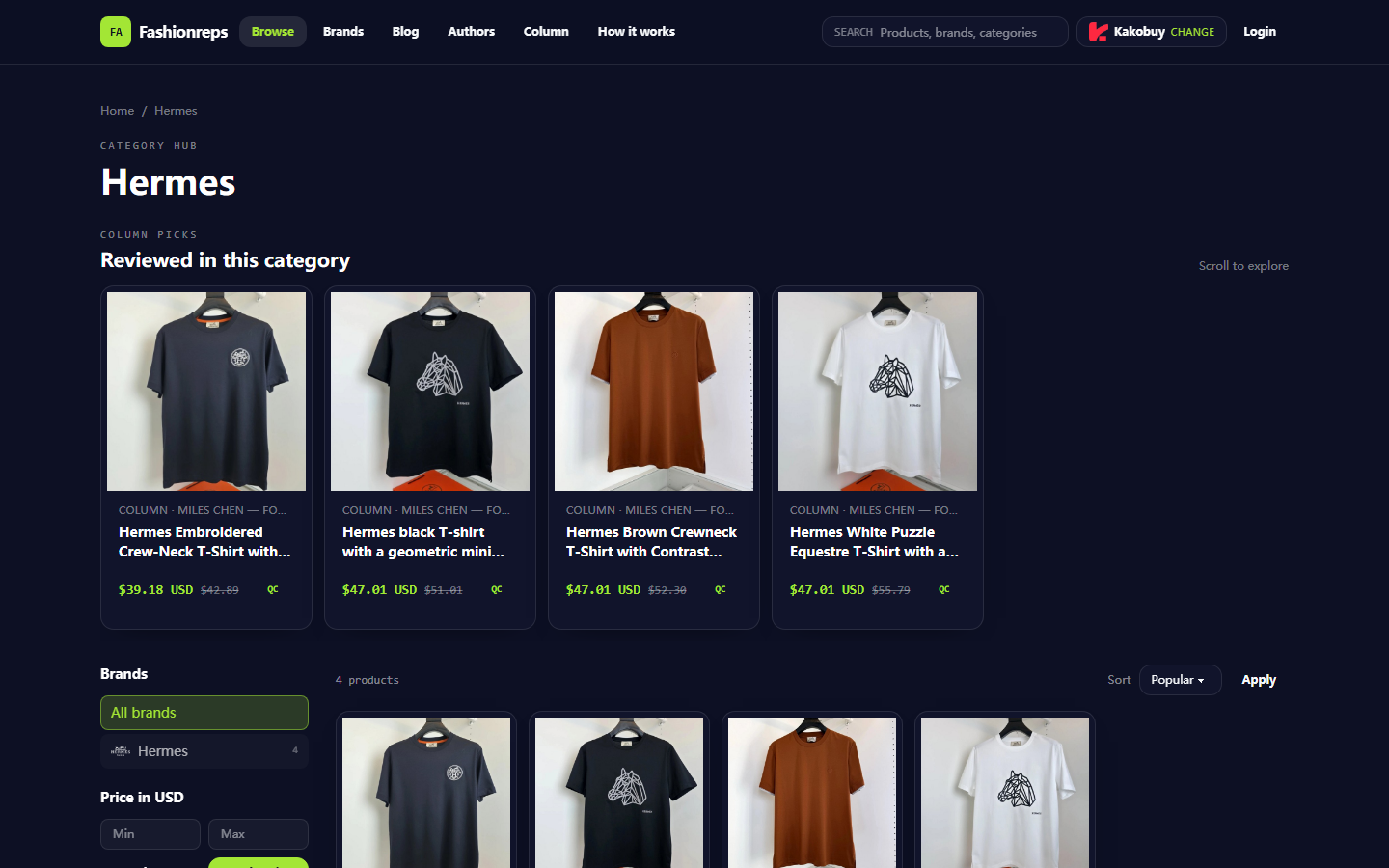
The currently verifiable fashion-reps Hermes category page shows Hermes clothing entries. The page provides product names, some design descriptions, reference prices, filter conditions, and a QC section, but the page itself cannot prove the size, material, inventory, or actual pattern details of a particular scarf. Therefore, scarf purchase decisions must be completed by going back to the specific product page and corresponding QC photos.
How to Record Size, Color, and Pattern Fields on the Product Page
Do not just save the product title. Break down the page information into fields that can be checked one by one to avoid placing an order just because a beautiful main image catches your eye.
It is recommended to record:
- Product name and the brand name currently displayed on the page.
- Labeled size, and whether the size unit is centimeters, inches, or not specified.
- Description of length, width, and whether the edges have rolled hems or trim.
- Color name, main color, and secondary colors. If the color name is unclear, record the original text on the page and do not replace it with a more specific color code.
- Pattern theme, repeating elements, and the positions of the central pattern and border pattern.
- Material and thickness description. If not explicitly stated, mark it as "not provided" and do not infer fabric feel or weight from the images.
- Reference price, currency, and page display date. The reference price is not equivalent to the final payment amount, and does not include agent service fees, domestic shipping, international shipping, taxes, or other fees.
- Whether there are QC photos, real-life photos, size charts, and seller's additional notes.
You can use the following simple recording method:
| Verification Item | Provided on Page | Still Needs Confirmation |
|---|---|---|
| Size | Length and width explicitly stated on the page with units | Whether there is error in actual measurement and what the measurement method is |
| Color | Color name used on the page and main color in the image | Whether there will be noticeable color difference under different screens and lighting |
| Pattern | Thematic elements in the title, description, and images | Whether pattern position, border ratio, and orientation are consistent |
| Thickness | Explicit thickness or weave description | Whether it is suitable for tying, draping, or head use |
If the product page only provides "standard size", "multiple colors available", or similar vague descriptions, do not record it as specific values. Missing information is itself part of the purchase decision. 🧾
How to Match Image Details with Text Descriptions Item by Item
Look at the text first, then the images, and finally check whether the two support each other. Images can help spot potential issues but cannot replace size charts, material descriptions, or actual measurement data.
You can check in the following order:
- Compare the pattern theme in the title with the main image. Do the elements stated in the title actually appear in the image, or are they just generalized descriptions?
- Look at the relative positions of the central pattern and border pattern. If the scarf needs to be folded or tied, will the central pattern be completely covered?
- Check the pattern orientation. Horizontal, vertical, or four-corner symmetrical designs will show different parts depending on the wearing method.
- Look at the edge finishing. Can you see rolled hems, trim, fringe, or other structures? If unclear, mark as pending confirmation.
- Check whether multiple images are of the same item. If backgrounds, folding methods, or pattern positions differ too much, ask to confirm the correspondence of the images.
- Note the limitations of the images. Low resolution, strong filters, overly dark lighting, or only showing partial views cannot support a complete judgment.
Colors in images are affected by light source, screen, and compression. If color is a core condition for purchase, ask for real-life photos under natural light and have the seller state whether the images have been color-adjusted. Do not treat colors in webpage screenshots as precisely reproducible color values. 📷
How to Distinguish Scarf Length, Thickness Information, and Wearing Scenarios
Appropriate size does not necessarily mean the wearing effect will be right. Length, width, and thickness together determine whether the scarf can accomplish the intended action.
Neck wrapping usually depends more on length and softness. If the length is insufficient, it may only be able to be simply draped; if the width is too large, folding will increase the volume around the neck. Shoulder draping depends more on overall coverage and edge drape, not just the longest side. Head use requires considering the wrapping area, fixing method, and remaining length after tying. As a bag decoration, size restrictions are relatively small, but the visible area of the pattern and edge durability are more important.
Thickness information should be recorded separately. When the page does not explicitly state it, do not infer actual thickness from words like "lightweight" or "premium" or from the wrinkling effect in photos. More useful follow-up questions are:
- Are there side or edge photos of the scarf laid flat?
- Can you provide weight measurements, and whether packaging is included?
- Can you indicate whether it is suitable for folding, tying, or only for draping?
- Is there an acceptable error range for the measured length and width?
Before purchasing, you can simulate the target size at home using paper or a soft measuring tape. For example, first mark out the range on the floor according to the length and width stated on the page, then simulate a tying or shoulder draping action. If this range cannot complete your wearing action, even if you like the pattern, you should not place an order based solely on the images. 📏
What Page Information Can Support and What Still Needs Confirmation
Page information is sufficient to support preliminary filtering, such as excluding items whose size is clearly unsuitable for the intended use, comparing the composition of different patterns, confirming whether the page provides QC photos, and organizing follow-up questions.
Page information is usually not sufficient alone to support the following conclusions:
- Determining the true material, feel, warmth, or weight.
- Determining that colors under natural light will be exactly the same as on screen.
- Determining that the item is in stock, or that the reference price is the final cost.
- Determining that the item shown in the images is exactly the same as what will be shipped.
- Determining that there are no flaws, color differences, size errors, or packaging damage.
- Determining that a certain wearing method will definitely be comfortable or suitable for all body types.
If the product page only has category information and no specific scarf page, the safest action is to pause the purchase and ask for a specific link, size chart, and corresponding real-life photos. Do not use prices, images, or descriptions from other clothing items of the same brand as evidence for the scarf.
What User Feedback Can Only Serve as Clues for Checks
User feedback can help you identify risk points that need verification, but it cannot replace the product page and QC evidence. In particular, avoid treating single review statements like "very big", "beautiful color", or "nice feel" as reproducible specifications.
When reading feedback, focus on extracting verifiable issues:
- Did anyone mention differences between measured size and the page?
- Did anyone mention color deviation, changes in pattern position, or edge workmanship?
- Did anyone state whether the received item matches the images?
- Did anyone provide clear photos, measurement methods, or specific usage scenarios?
- Is the feedback from the same item, not other styles in the same store?
Only when feedback can be cross-supported by specific page evidence or real-life photos is it appropriate to use as a strong purchase clue. Short reviews without complete context can only be used to generate a list of follow-up questions, not to prove quality or suitability.
Checklist for Links, Specifications, and Evidence Before Ordering
Before ordering, confirm item by item:
- The specific product page is still accessible, and is not an empty page, a tag page, or an invalid redirect.
- The product name and images belong to the same item, not other products in the brand category page.
- Length, width, and units have been recorded; missing items have been clearly marked.
- Color name has been saved as the original text on the page, without guessing color codes.
- Pattern theme, central position, border, and orientation have been compared with the images.
- Thickness, material, and edge finishing have textual or real-photo evidence; items without evidence are not concluded.
- QC photos correspond to the item, and are clear enough to check key areas.
- Reference price, currency, service fees, shipping fees, taxes, and return/exchange conditions are confirmed separately.
- You know the target wearing scenario, and have simulated at least one actual usage with the size.
- Personal order number, payment information, complete shipping label, and other sensitive information have not been disclosed to unrelated persons.
If a core piece of information is missing, you can organize the questions into one concise follow-up message: Please provide the measured length and width of this scarf, the units, natural light color photos, the entire pattern, and the recommended wearing method. The more specific the question, the higher the probability of getting a useful answer. ✅
Final Action: After Verification, Decide to Keep, Ask More, or Pause
After verification, categorize the item into three groups:
- Keep: Size, pattern, and wearing scenario all have sufficient evidence, and remaining uncertainties will not affect the main use.
- Ask more: The item is worth further consideration, but one key piece of information is still missing regarding size, thickness, color, or pattern correspondence.
- Pause: Core information has been missing for a long time, the page cannot confirm the specific item, or the price and subsequent costs cannot be reasonably estimated.
This method saves not a fixed amount of money, but reduces the costs of returns, reselling, and repurchasing caused by unsuitable size, mismatch in pattern, or mismatched use. The cost is that extra recording, comparison, and waiting for replies are needed before ordering; it is more suitable for buyers who value pattern composition, wearing method, and completeness of evidence. It is not recommended to complete a purchase based solely on category page images when the item is urgently needed, the seller cannot provide any supplementary information, or you only accept explicit guarantees of material and size.
Continue reading