From the blog
fashionreps Hoodie Evidence Review
Put the product page, size chart, seller photos, and QC photos into the same inspection logic before placing an order to reduce misjudgments caused by "it looks...
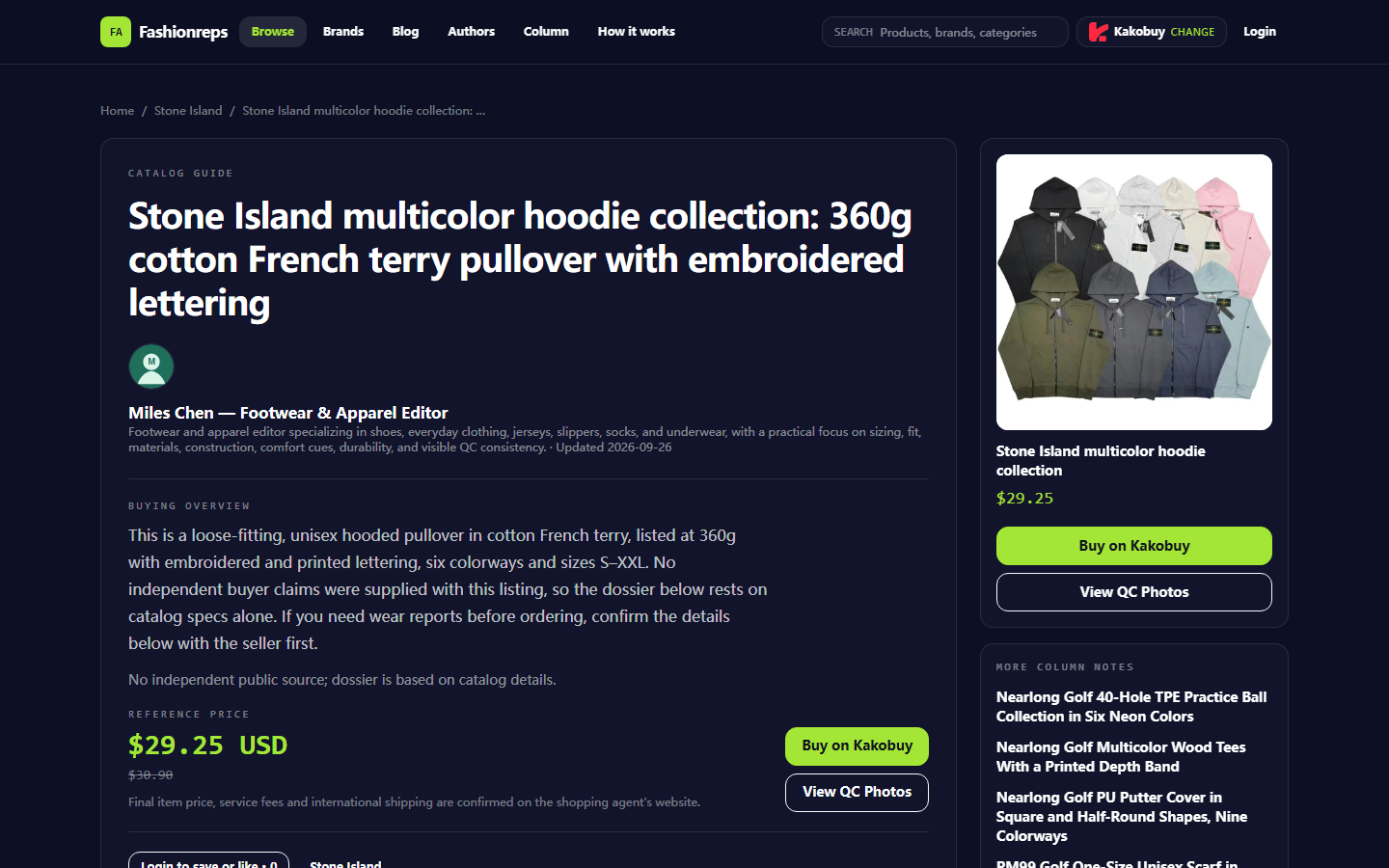
Put the product page, size chart, seller photos, and QC photos into the same inspection logic before placing an order to reduce misjudgments caused by "it looks similar."
Who This Review Helps Decide
This review is for buyers who have already found a hoodie on fashion-reps but haven't decided whether to place an order, switch to a different style, or ask the seller for more information. It doesn't answer "which one is definitely the best," but helps you evaluate a hoodie from the perspectives of fit, fabric, workmanship, and QC risks.
If you only have a blurry cover image, or the product page lacks size, material, detailed photos, and seller descriptions, this article cannot directly lead you to a purchase conclusion. The safer approach is to first gather more evidence before deciding to pay. 🧾
After reading, you should be able to do three things:
- Determine whether this hoodie fits your wearing scenario
- Confirm what key information is still missing before ordering
- After receiving QC photos, decide whether to keep it, exchange it, request additional photos, or cancel
Verification date of this article: 2026-09-29. Since prices, stock, size charts, shipping methods, return policies, and product link status may change, before ordering, you should refer to the current product page on fashion-reps, the seller's description, and your warehouse QC photos.
Evidence Boundaries: Product Page, Specs, Images, and Feedback
When evaluating a fashionreps hoodie, it's best not to rely only on the title and main image. The title usually only tells you the general category, and what really affects the purchase outcome are the size chart, fit image, material description, detail images, information the seller can answer, and the QC photos after the item arrives at the warehouse.
Available evidence can be divided into four categories:
- Product page information: title, color, size, material description, actual photos, shipping options, and stock status
- Specification information: chest circumference, length, shoulder width, sleeve length, weight, or fabric composition
- Image evidence: front, back, hood, ribbing, drawstrings, print, embroidery, wash label, and hang tag
- Subsequent evidence: warehouse QC photos, weight, packaging condition, seller replies, and after-sales window
Here we need to be particularly cautious: an image that "looks thick" does not mean a high actual fabric weight, and "looks loose" does not mean it will fit the same on your height and weight. The purchase judgment of a hoodie must go back to quantifiable information: length, chest circumference, shoulder width, sleeve length, fabric composition, and weight. 👕
If the product page does not have a clear size chart, or different colors use images from different batches, do not take one image as evidence for all colors. Buyers should ask the seller to confirm the actual information for the corresponding color and size before ordering.
Fit First: How to Judge Loose Fit, Length, and Shoulder Line
The most common pitfall with a hoodie is not "does it look good," but that the fit does not match your expectations. The same size M may be short and wide, long and narrow, with a significantly dropped shoulder line, or close to a regular fit.
When judging fit, start with chest circumference and length. Chest circumference determines the room for body movement, and length determines the upper body proportion. For a loose streetwear look, you usually need significantly more room than your actual chest measurement; for layering under a jacket, you shouldn't just pursue heavy and oversized. Shoulder width and sleeve length should be considered together, because a dropped shoulder style will make the sleeve start from a lower position, and looking at sleeve length alone may lead to misjudgment.
It is recommended to check in the following order:
- Use your existing well-fitting hoodie to measure chest circumference, length, shoulder width, and sleeve length flat
- Compare with the product page size chart, not just S/M/L/XL
- Confirm whether the size chart units are centimeters or inches
- Allow for 1–3 cm manual measurement error
- If you are between two sizes, decide based on length and chest circumference first, not just on weight recommendations
If you want a short boxy effect, length is more critical than chest circumference; if you want hip coverage or winter inner layering, both length and sleeve length should be sufficient. Fit is not determined by a single number, but by the wearing result formed by several measurements together.
How to Break Down and Check Fabric and Workmanship Information
Fabric judgment should avoid a common misconception: mixing up "thick," "heavy," and "premium." Thickness, fabric weight, hand feel, elasticity, pilling risk, and warmth are related but not exactly the same.
If the product page mentions cotton, polyester, fleece, terry, heavyweight, etc., you need to further confirm whether these descriptions are supported by corresponding images or specifications. For example, inner fleece is usually warmer, but it may also attract lint more easily; terry cloth may be more breathable, but its warmth in winter may not be strong. Without weight information, you should not directly claim it is a heavyweight hoodie.
Workmanship can be broken down into the following items:
- Hood: whether it is three-dimensional, whether the hood opening collapses, whether the drawstring holes are symmetrical
- Neckline: whether the stitching is flat, whether there is reinforcement or taping at the back neck
- Cuffs and hem: whether the ribbing is loose, whether the rebound shows obvious deformation
- Pockets: whether the pocket openings are symmetrical left and right, whether the stitching is crooked
- Print or embroidery: whether the position is centered, whether the edges are clean, whether the color matches the product image
- Wash label and hang tag: whether they match the product page description, but do not treat tags as authenticity guarantees
For platforms like fashionreps that focus on discovery and purchasing agent links, buyers should regard product page information as "evidence to be verified" rather than a final promise. What really determines whether to proceed with shipping is usually the QC photos after the item arrives at the warehouse and the after-sales window that the seller can handle. 🔍
QC Photo Focus: Hood Shape, Drawstrings, Ribbing, and Print Position
After receiving QC photos, don't rush to look only at the overall front. Defects on a hoodie are often hidden in the edge areas: crooked hood, asymmetrical drawstrings, loose cuffs, uneven pocket openings, offset print, which can easily be missed if you only look at the main image.
You can look in the order of "overall to local":
| QC Item | What to Look For | Situations Requiring Additional Photos |
|---|---|---|
| Front/back laid flat | Whether the body is skewed, whether the left and right sleeves are obviously asymmetrical | Image angle tilted, garment not laid flat |
| Hood and drawstrings | Hood opening shape, drawstring length, hole symmetry | Hood folded or drawstrings obscured |
| Chest or back design | Position, size, color, edge clarity | Design affected by reflection, crease, or folding |
| Ribbing and pockets | Cuffs, hem, pocket opening stitching | No close-up image of edges |
| Measurement | Chest, length, shoulder width, sleeve length | Large difference between size chart and actual measurement |
If the QC photos show slight wrinkles, it generally cannot be directly judged as a quality issue, because transportation and folding can cause temporary creases. However, if there are obvious stains, holes, print peeling, embroidery thread breaks, severe color deviation, or significant size mismatch, you should first suspend shipping and contact the seller or platform customer service to confirm the handling method.
It should be noted that QC photos can help judge the current physical condition, but they cannot replace long-term wear testing. Without actual washing and wearing evidence, you should not assert that it will never pill, shrink, or be durable in the long run.
Suitable and Unsuitable Wearing Scenarios
If this fashionreps hoodie has a complete size chart, clear QC photos, stable design position, and fabric information matching its purpose, it is more suitable for the following scenarios:
- Daily commute or school, focusing on comfort and easy matching
- Autumn/winter layering, focusing on length, shoulder width, and hood thickness
- Streetwear loose styling, focusing on chest room and dropped shoulder effect
- Photography or styling, focusing on design position and overall silhouette 📸
Situations where ordering is not recommended are also clear:
- Product page only has a blurry cover image, no size chart or detail images
- Seller cannot confirm material, color, or size tolerance
- You are very sensitive to length, but the page has no reliable actual measurement data
- Design position is the core purchase reason, but QC photos cannot show it clearly
- You require guaranteed authenticity, official authorization, or brand after-sales service
The risk with this type of hoodie is not that it cannot be bought, but that you cannot treat it as a low-risk purchase when evidence is insufficient. Especially for high-priced, heavyweight, or complex print styles, returns and international shipping costs can make a misjudgment very expensive.
Items to Ask or Photograph Before Ordering
The information most worth asking before ordering is that which directly affects "whether it can be worn, whether it is worth shipping, and whether problems can be handled after they occur." Don't ask overly broad questions like "Is the quality good?"; such questions rarely get actionable answers.
More effective questions include:
- Is this color and size in stock
- Is the size chart based on actual flat measurements
- What is the allowed tolerance for chest, length, shoulder width, and sleeve length
- Is the fabric fleece or terry, and is there weight information
- Is the print screen printing, embroidery, or another technique
- If obvious stains, damage, or size errors are found after arrival at the warehouse, is return or exchange supported
- Can additional close-up photos of the hood, cuffs, hem, and design be taken during the QC stage
If you have already placed an order and are waiting for the item to arrive at the warehouse, it is recommended to prepare a QC checklist in advance. This way, when photos come, you can quickly decide whether to request additional photos, rather than discovering missing key angles just before the package is about to be consolidated. ⏱️
Also pay attention to the practical issues in logistics. A hoodie is usually thicker than a T-shirt, takes up more volume. Package consolidation may save repeated first weight or handling costs, but it may also increase volumetric weight, declared package value, and the risk of loss or damage in a single shipment. Whether to consolidate should be decided based on actual weight, route restrictions, destination country tax rules, and acceptable risk, not a fixed answer.
Final Action: Keep, Exchange, or Continue Verification
The final decision can be divided into three categories.
The first is to keep. This applies when the size chart is complete, product page images are clear, seller description is consistent, QC photos show no obvious defects, and the hoodie's purpose matches your scenario. At this point, you can proceed with package consolidation or shipping, but still need to check weight, route restrictions, customs declaration information, and possible taxes in the destination country.
The second is to exchange. This applies when product page evidence is insufficient, size risk is too high, key design is unstable, or QC photos already show obvious problems. Exchanging is not a waste of time, but controlling losses before international shipping.
The third is to continue verification. This applies when the overall appearance is acceptable, but one key piece of evidence is missing, such as a cuff close-up, back print position, actual length measurement, or fabric inner photo. In this case, do not rush to confirm shipping; first request additional photos or ask more questions.
The conclusion is simple: whether this type of fashionreps hoodie is worth buying cannot be judged solely by the cover image. A more reliable approach is to use the size chart to judge fit, material and detail images to judge expectations, QC photos to judge current physical condition, and then factor in shipping costs, return window, and consolidation risks.
The money saved comes from identifying unsuitable styles earlier and avoiding shipping obvious problems internationally; the increased risk is mainly that additional photos and communication will extend processing time. It is suitable for buyers who are willing to make decisions based on evidence and can accept waiting for QC; it is not suitable for those who need official brand guarantees, immediate receipt, or cannot accept size and workmanship variations. ✅
Agent Platform Shopping FAQ
1. What product categories can I find in fashion-reps' spreadsheet?
fashion-reps' online spreadsheet includes shoes, clothing, handbags, accessories, sports team jerseys, fragrances, hats, scarves, belts, and a variety of home and daily essentials.
Continue reading