From the blog
Evaluating Polo Ralph Lauren Plaid Shirts: Multi-Color QC
Verification date: October 3, 2026 This article addresses a specific problem: when you want to find Polo Ralph Lauren plaid shirts through a shopping agent and...
Verification date: October 3, 2026
This article addresses a specific problem: when you want to find Polo Ralph Lauren plaid shirts through a shopping agent and consider purchasing multiple colors at once, how to record candidate items, review orders, judge whether QC photos are sufficient, and decide whether to proceed, switch styles, or pause before warehouse consolidation.
First, let me clarify the evidence boundary: the currently verifiable page is the Fashionreps QC page for Polo Ralph Lauren embroidered pony logo T-shirts. The page shows 5 styles under this source and provides individual style entry points; existing information cannot prove the presence of plaid shirts, nor can it prove any specific colors, sizes, inventory, prices, materials, or seller information. Therefore, this article provides a set of evaluation and recording methods applicable to plaid shirts, rather than making a pass, recommendation, or purchase conclusion about a specific plaid shirt.
Who This Polo Ralph Lauren Plaid Shirt Platform Review Helps
This guide is suitable for the following types of buyers:
- Those who want to compare multiple colors such as black-and-white plaid, blue-and-white plaid, and brown plaid at once, but don't want to mix different links in one order.
- Those who need to establish evidence records before ordering to avoid selecting the wrong color, size, or style.
- Those who plan to wait for warehouse QC photos before deciding whether to consolidate and ship.
- Those who want to distinguish between product page facts, agent platform information, and personal judgment.
After reading, you should be able to perform four actions:
- Create an independent candidate record for each color.
- Check style, size, quantity, and notes before payment.
- Use QC photos to check plaid alignment, collar, buttons, shoulder lines, and obvious color differences.
- Decide to proceed, request additional photos, switch styles, return/exchange, or pause based on evidence completeness.
Cases where this does not apply include: you already have complete official product information and only need to check real-time shipping costs; or you require confirmation of a specific agent platform's current prices, inventory, return/exchange policies, and delivery times, but have not provided an accessible corresponding platform page. These facts need to be re-verified before ordering.
Visible Facts and Editorial Judgment: How to Avoid Treating Platform Promotions as Conclusions
Fashionreps' visible page provides product discovery, QC images, and shopping agent selection entry. The page explains that the purchase button will redirect to the user-selected agent platform, and orders, payments, and logistics are handled by the external agent website. From this, only a limited conclusion can be drawn: Fashionreps can serve as an entry point for product discovery and QC materials, but cannot alone prove a specific agent platform's prices, inventory, after-sales commitments, or logistics performance.
The existing QC page title corresponds to the Polo Ralph Lauren embroidered pony logo T-shirt series, not plaid shirts. The page lists 5 style names and SKUs under the same source, but the provided information does not give plaid weave, shirt collar type, button configuration, fabric composition, or color inventory. Therefore, any claims that "this plaid shirt is good quality," "multiple colors can be purchased," or "sizing is stable" lack current evidence support.
| Information Category | What Can Be Confirmed Now | What Cannot Be Confirmed Now |
|---|---|---|
| Product Discovery | Page has a QC entry for Polo Ralph Lauren related products and lists 5 styles | Cannot confirm the target plaid shirt is among them |
| Image Evidence | Page provides QC image entry | Cannot confirm the specific color and size corresponding to images based solely on page title |
| Agent Process | Page shows a shopping agent can be selected; orders and logistics handled by external agent | Cannot confirm real-time fees, inventory, delivery times, or return/exchange results for any agent |
| Purchase Decision | Can create candidate and pending verification lists | Cannot make purchase, authenticity, or quality guarantee conclusions based on this |
Article image: Fashionreps product QC page screenshot.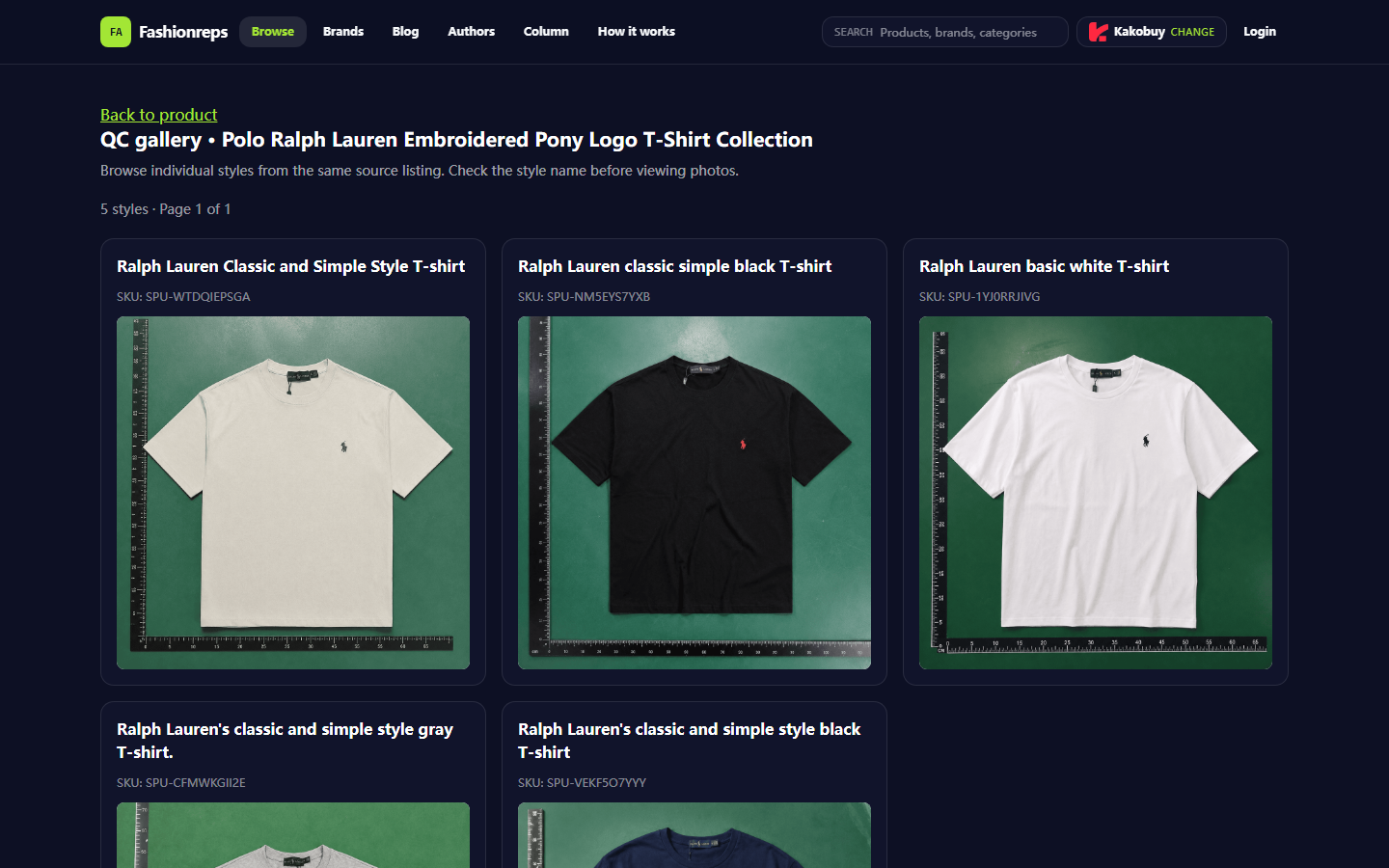
Editorial judgment should be based on visible evidence. For example, the page has QC images, which only indicates there is an entry to view product images; whether it is sufficient to judge a plaid shirt depends on whether the images cover the complete front, back, collar, cuffs, buttons, size label, and key details. When images are insufficient, the correct action is to supplement evidence, not to fill gaps with brand impressions.
Multi-Color Sourcing: How to Record Colors, Plaid, Sizes, and Candidate Links
The most common problem with multi-color ordering is not too many colors, but that different colors actually correspond to different styles, sellers, or size charts. It is recommended to create a separate record row for each color, not just write "black, blue, brown one each" in the notes.
Each candidate should at least record the following:
- Product name displayed on the page.
- Product link or platform internal identification.
- Color original text and Chinese working name.
- Size options and corresponding chest, length, shoulder width, and sleeve length.
- Material information displayed on the page; if not shown, mark as "not provided."
- Seller, inventory, and price shown on the page; if not verified, leave blank.
- Confirmation that it is a plaid shirt, not a T-shirt, jacket, or other top.
- Page screenshot or QC entry verification time.
Color naming should preserve the page's original text as much as possible. For example, if the page says "navy plaid," don't directly change it to "dark blue classic plaid," because the latter may be editorial understanding rather than page fact. For multi-color items, also check whether the plaid is only a color change, or if the plaid ratio, base color, collar type, or button color also changes.
It is recommended to set three statuses for candidates:
- Pending verification: page found, but color, size, or image evidence incomplete.
- Ready to order: product name, color, size, and price have been checked item by item, but still subject to real-time changes on the agent platform.
- Paused: page inaccessible, images mismatch, key specifications missing, or cannot confirm if multiple colors are the same style.
Do not assume multiple colors share the size chart, seller, and inventory just because they appear on the same collection page. Each color needs separate verification.
Ordering and Payment: How to Review Quantity, Notes, Order Status, and Fees
The Fashionreps page itself cannot replace the external agent platform's order confirmation page. After entering the agent platform, it is recommended to perform an item-by-item review before payment.
The first step is to verify product identity. Confirm that the name, color, size, and quantity in the order line match the candidate record. If purchasing multiple colors of the same style, each color should appear as a separate order line; this makes it easier to track anomalies after warehouse arrival.
The second step is to verify notes. Notes should only contain actionable information, such as "Please purchase according to the page color options," "Please confirm size is M," "After warehouse arrival, need photos of front, back, collar, and size label." Do not use "authentic" or "absolutely flawless" as actionable requirements, and do not write expectations that cannot be verified by the agent as guarantee conditions.
The third step is to break down fees. At least distinguish between product amount, domestic shipping, agent service fee, possible value-added service fee, and subsequent international shipping. Current information does not provide these real-time numbers, so this article cannot give savings amounts or fee comparisons for any agent.
The fourth step is to save status. After payment, keep the order number, color, size, quantity, payment time, and current status. Status changes should be recorded as "pending payment, paid, pending purchase, purchasing, in warehouse, QC pending confirmation, pending processing." Payment success does not mean the product has been purchased, and purchase completion does not mean QC is passed.
If the order page shows color substitution, out of stock, size change, or price change, pause additional payments and reconfirm whether the change is acceptable. For multi-color orders, especially prevent one color from being automatically replaced with a similarly named one.
QC Focus: Plaid Alignment, Collar, Buttons, Shoulder Lines, and Color Difference Evidence
QC for plaid shirts should not only look at brand labels, overall folded photos, or a single front thumbnail. At least the following evidence is needed:
- Front flat lay photo: check the plaid direction, ratio, and obvious misalignment on left and right front panels.
- Back flat lay photo: check the back center line, shoulder blade area, and hem for abnormal offset.
- Collar close-up: check collar points, collar stand, stitching, and whether plaid is roughly continuous on both sides.
- Button and placket close-up: check button color, spacing, buttonholes, and plaid continuity on both sides of the placket.
- Shoulder line and armhole photo: check if shoulder lines are symmetrical and if there is obvious distortion or bunching at the armhole.
- Size label and measurement photo: confirm actual size, and request flat measurements of key dimensions.
- Color reference: compare with page color name or product images under clearly stated lighting conditions.
Plaid alignment cannot be summarized as "looks good." Specific locations should be recorded, such as "obvious horizontal misalignment at the junction of left front panel and placket" or "insufficient close-up near collar point, temporarily cannot judge." If photo angle, lighting, or folding affects judgment, request additional photos instead of writing uncertainty as a defect or pass.
Color difference also requires caution. Display, shooting lighting, and compression all affect color. QC images can help detect obvious color shifts, but cannot replace standard color cards or physical inspection. If multiple colors need to be purchased as a set, it is best to require photos of each item under similar lighting, to avoid judging one item's color based on another.
A simple recording format can be used:
- Color: whether page name and actual photo color match.
- Plaid: whether there are visible misalignments on front, back, collar, and placket.
- Workmanship: whether buttons, stitching, hem, and cuffs have issues needing attention.
- Size: whether label size, measured data, and purchased size match.
- Evidence status: sufficient, need additional photos, cannot judge.
- Decision: keep, exchange, return, or pause.
This recording describes observable phenomena in photos, not laboratory testing, nor a conclusion on brand authenticity.🧵
Warehouse and Consolidation: Receiving, Photographing, and Packing Options for Multiple Shirts
After multi-color orders arrive at the warehouse, the first task is to confirm the quantity and colors are complete. Do not only look at total package quantity; compare each item against the order record to ensure every color, size, and order line corresponds.
The second task is to establish individual identification. Use order number, color, size, and inbound photo combination for identification to avoid mixing similar colors. If product labels or packaging are not clearly marked, supplement records at the warehouse stage.
The third task is to decide whether to consolidate. Consolidation may reduce repeated first weight or some handling costs, but may also increase package volume, single loss concentration, and declaration management difficulty. Shirts are generally easier to consolidate than heavy outerwear, but ultimately depends on quantity, packing method, destination country rules, route restrictions, and volumetric weight.
Split shipping may increase fixed costs but can reduce single package loss scope or resolve route, declaration, and weight restrictions. Do not decide solely based on "consolidation is cheaper." First obtain warehouse weighing, package dimensions, route quotes, and applicable restrictions, then compare total costs and risks.
Current reliable real-time shipping costs, packaging fees, or destination country taxes are not available, so this article cannot calculate savings for a specific combination. Before ordering, use the following formula:
Total cost = product amount + domestic shipping + agent service fee + warehouse value-added service fee + international shipping + taxes that may be incurred according to law
When comparing consolidation and split shipping, record the following:
- Total quotes and currencies for both options.
- Chargeable weight, actual weight, or volumetric weight.
- Whether packaging, insurance, or special handling fees are included.
- Whether destination country has taxes, import restrictions, or declaration requirements.
- Maximum exposure amount if a single package is lost or damaged.
If declaration is required, fill it out truthfully according to destination country requirements; do not reduce apparent costs through under-declaration, splitting orders to avoid taxes, or evading inspection.📦
Returns and Logistics: Applicable Conditions, Anomaly Points, and Unknown Limitations
Return/exchange decisions must be based on the actual agent platform's order policies, seller rules, and time windows. Fashionreps' QC page alone cannot prove that a product can be returned or exchanged, nor who bears the return/exchange costs.
After receiving QC photos, if color, size, style, or quantity does not match the order record, submit evidence as soon as possible within the platform's processing window. Evidence should include order line, product identification, photos of problem areas, and a concise description. Do not just write "poor quality," but state "purchased color A, but photos clearly show B" or "ordered size M, but label shows L."
The following situations usually require supplementing evidence first, not immediately drawing conclusions:
- Collar or placket is folded and obscured.
- Color is affected by lighting and cannot correspond to page name.
- Only overall photos, no size label or measurement photos.
- Multiple items not photographed separately.
- Image clarity insufficient to judge plaid alignment.
During logistics, status should be divided into order processing, warehouse inbound, QC completed, ready to ship, handed to carrier, in transit, customs processing, and out for delivery. Customs status does not mean violation, nor does it necessarily mean taxes will be incurred; specific results depend on destination country regulations, declaration documents, product category, and carrier handling.
If the package has prolonged lack of updates, address errors, customs requests for additional documents, or outer packaging damage, first check the carrier and agent platform's handling instructions before submitting a ticket. Do not publicly share order numbers, complete waybills, passports, payment cards, or other personal information.🔒
Pre-Purchase Checklist: When to Supplement Evidence, Switch Styles, or Pause
Conditions to proceed:
- Confirmed the product is indeed the target plaid shirt, not a T-shirt or other garment from the same series.
- Each color has an independent page record and size record.
- Price, inventory, and fees have been verified on the agent platform's current page.
- QC images cover front, back, collar, placket, size label, and key workmanship.
- Warehouse has confirmed quantity, color, and size match the order.
Conditions to supplement evidence first:
- Page only has series name, without clearly distinguishing specific colors.
- Product images and QC images cannot correspond.
- Only folded photos, cannot judge plaid or shoulder lines.
- Key measurements have no data.
- Agent platform's fees, return window, or route restrictions not stated.
Conditions to consider switching styles or pausing:
- Target is a plaid shirt, but current evidence actually only supports a T-shirt page.
- Color, size, or seller information contradict across multiple pages.
- QC photos show obvious style, color, or quantity errors.
- Key questions cannot be answered within the platform's processing window.
- After consolidation, cost savings are minimal, but single package value, route restrictions, or customs risk increases significantly.
This method's potential savings come fro
Continue reading