From the blog
Corteiz Hoodie: fashionreps Spreadsheet vs Google Sheets
What Problem Does This Catalog Sorting Solve? When you find Corteiz hoodies in the fashion-reps product catalog, the real task isn't just copying product names...
What Problem Does This Catalog Sorting Solve?
When you find Corteiz hoodies in the fashion-reps product catalog, the real task isn't just copying product names into a spreadsheet—it's confirming three things: is this the target product, is the size information sufficient for choosing, and does the saved link still lead back to the corresponding page. After sorting, you should have a reviewable list of candidates and be able to explain why each one is kept, pending verification, or excluded. 🧭
This article compares the division of labor between two tools: fashion-reps' website-style product catalog is good for discovering, browsing brands, and viewing product pages; Google Sheets is good for organizing sizes, colors, links, verification status, and notes into filterable, collaborative records. The two cannot replace each other.
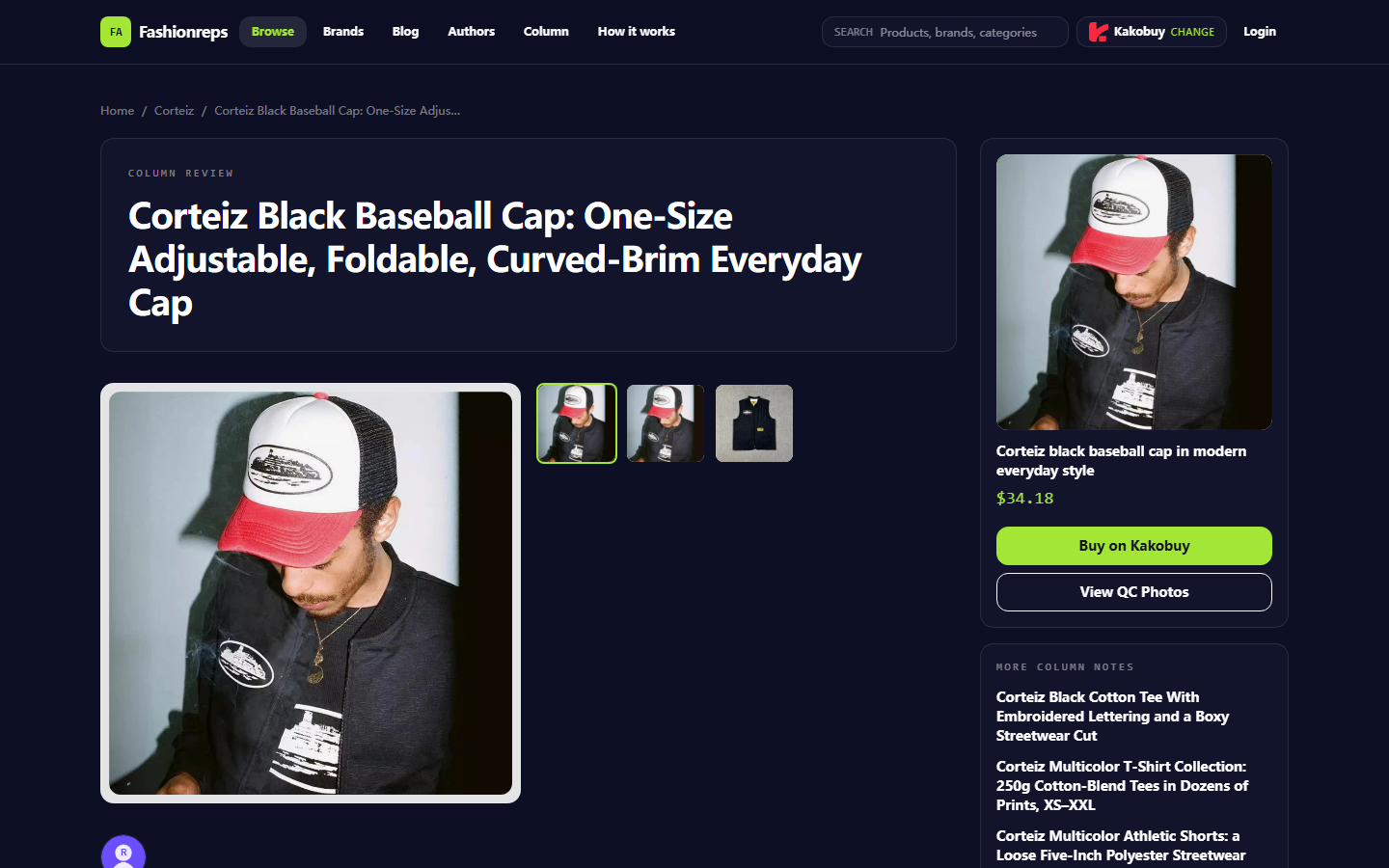
Image: Example of a fashion-reps catalog page. This image is for illustrating the catalog browsing entry and how product page information is organized, and is not direct evidence of hoodie sizes or stock.
How to Locate Brands and Categories in fashionreps' Website-Style Spreadsheet
Start from the brand entry, on-site search, or product catalog, not by immediately creating an empty sheet. The page has visible navigation including brand, blog, authors, usage, and search entry; product pages also display product title, category, editorial description, reference price, purchase platform options, and related products. This structure is suitable for the first round of discovery: confirm whether there are Corteiz-related products, and open each candidate's individual page.
For locating, it is recommended to follow this order:
- Search for Corteiz first, then observe whether the results are hoodies, T-shirts, hats, or other categories.
- Open the individual product page and check the category in the title; don't judge solely from the search result cards.
- Record the size range, colors, material description, and page update time shown on the product page.
- Copy the product link into the pending verification column; do not use search pages, brand pages, or tag pages as the final product link.
- For results that only show the brand name, image, or vague title, mark them as pending verification, not directly as candidates.
Existing page examples suggest that Corteiz product pages may simultaneously include reference price, size hints, purchase platform options, and quality description. However, the example page itself is a Corteiz hat and does not prove that hoodies have the same size, material, or price information. Therefore, the hat page can only help you understand the catalog structure, and cannot replace verification of the hoodie product page. 🔎
How to Set Up Size, Color, and Link Fields in Google Sheets
The value of Google Sheets lies in turning scattered information from multiple product pages into unified records. It is recommended to put only one product candidate per row, and avoid mixing multiple colors or sizes in a single cell, unless the page itself only provides summary information.
| Field | Suggested Content | Verification Focus |
|---|---|---|
| Product Title | Full name shown on the product page | Whether it clearly says hoodie or sweatshirt |
| Brand | Corteiz | Whether it matches the product page category |
| Category | Hoodie, hat, T-shirt, etc. | Exclude other categories of the same brand |
| Size Range | For example S–XXL, or original page text | Whether there are actual measurements like chest and length |
| Color | Colors or variants listed on the page | Do not treat image colors as official names |
| Product Page Link | Individual product page URL | Whether it still leads to the same product when opened |
| Page Update Time | Date shown on page or verification date | Distinguish between page update and this check date |
| Status | Verified, pending supplement, invalid, excluded | Clarify next action |
| Notes | Size risks, information conflicts, image differences | Keep basis for judgment |
If the page does not provide a numeric size chart, do not infer chest or length measurements from S, M, L on your own. You can record "only letter sizes, no flat measurements" and set confirming measurements with the seller as the next step. For loose fits, drop shoulders, or different batches, letter sizes alone cannot represent the wearing effect.
The link field should preferably use the full URL, and enable cell wrapping or set a fixed column width to prevent team members from accidentally clicking adjacent rows. The status field can use dropdown options, at least keeping five statuses: "pending verification," "verified," "insufficient information," "link invalid," and "excluded." This way, when filtering, everyone can quickly see the candidates that still need processing. ✅
Item-by-Item Cross-Check of Product Page, Images, and Links for the Same Candidate
When verifying a candidate, don't just look at the title. It is recommended to break the product page information into four layers:
- Title layer: Confirm brand, category, and possible style name.
- Variant layer: Confirm whether colors and sizes are clearly listed on the page.
- Image layer: Observe whether the images belong to the same product, but do not write visual observations as conclusions about material or quality.
- Link layer: Open the link from the sheet and confirm that the page does not redirect to the brand homepage, a blank page, or another product.
Images can help you spot obvious inconsistencies, such as the title saying hoodie but the image showing a hat; or the title saying black but the variant area has no black option. However, images alone cannot prove fabric composition, weight, warmth, or actual fit. When you need such information, rely on the product page text, seller's size chart, or verifiable measurement records.
It is recommended to add a "cross-check result" column in Google Sheets, using short and specific expressions, such as "title and category consistent, numeric size chart missing," "link works, but color variants not listed," "image category inconsistent with title, excluded." Do not write judgments like "looks good" or "should fit" that cannot be reviewed.
Difference in Use Between Website Card Browsing and Spreadsheet Filtering
The website-style catalog is suitable for continuous browsing. You can start from the brand, category, or search results to enter product pages, and judge which candidates are worth recording through titles, images, and page context. The page may also provide related products, purchase platform options, and curated content, which help discover adjacent candidates.
Google Sheets is suitable for horizontal comparison and long-term maintenance. You can filter all candidates with "insufficient size information," or only look at records with confirmed valid links but missing color fields. For multi-person collaboration, filter views, comments, and update times also reduce duplicate verification.
The difference can be summarized as: the website is for discovery and reading, the spreadsheet is for archiving and comparison; the website provides page context, the spreadsheet provides unified fields; the website is better for judging "whether to record," and the spreadsheet is better for judging "which one to process next." 📋
Do not treat Google Sheets as a permanent source of product facts. Prices, stock, sizes, colors, purchase platforms, and link status may change. The spreadsheet stores a snapshot of a particular verification, which must include the verification date, and the product page must be reopened before placing an order.
Verification Boundaries for Link Failures, Missing Fields, and Update Times
When encountering link issues, first distinguish three situations: page cannot be opened, page opens but content is empty, page opens but has changed to another product. None of these should be kept as "verified." You can change the status to "link invalid" or "insufficient information," while keeping the original link and check date for later tracking.
Missing fields also need graded handling:
- Color name missing, but image and size information complete: keep as pending supplement.
- Only letter sizes, no measurements: keep, but explicitly note size risk.
- No individual product page, only brand or tag page: not a final candidate.
- Product title and page body belong to different categories: exclude, and write the reason in notes.
- Page price exists, but no service fee, international shipping, or tax explained: can only be recorded as reference price, cannot calculate final landed cost.
The verification date should be recorded separately from the page's own update time. The page may show an earlier update date, while your check happened on another date; both are meaningful. For highly volatile information such as product links, stock, and prices, recheck before publishing or ordering. The page examples provided in this article are only for illustrating catalog fields and browsing methods, and do not confirm that any Corteiz hoodies are currently available, current price, or stock.
Different Scenarios for Quick Discovery vs. Long-Term Organizing
If your task is to quickly find a few potentially relevant products, first use fashion-reps' brand entry, on-site search, and product page browsing. The discovery phase focuses on judging whether the category and page are worth recording, and you don't need to fill all fields immediately.
If your task is to compare multiple Corteiz hoodie candidates over the long term, or need to collaborate with others, transition to Google Sheets as soon as possible. Unify the recording of size, color, link, page date, and risk notes, so that later you can filter by "size information complete," "link still valid," or "needs seller confirmation."
It is not recommended to copy all products from the entire site into a spreadsheet at once. That will mix in hats, T-shirts, and other categories, and also increase dead links and duplicate records. A safer approach is to first filter out candidates directly relevant to the current task, then open each individual product page one by one.
Combined Workflow of Website and Google Sheets
You can complete a reviewable sorting in the following order:
- Search for Corteiz in the website catalog, and record candidates that might be hoodies.
- Open each individual product page, and exclude pages for hats, T-shirts, and those with unconfirmable categories.
- Create a record with one candidate per row in Google Sheets.
- First fill in title, category, and product page link, then fill in size and color.
- Add risk notes for candidates lacking numeric measurements, color variants, or material information.
- Open links one by one from the spreadsheet to confirm the page still corresponds to the original candidate.
- Fill in verification date and status, and do not mark incomplete records as verified.
- Before placing an order, recheck price, stock, size, service fee, international shipping, and destination country tax information.
For size selection, the final judgment should return to specific measurement data: compare the flat measurements of your own well-fitting garments with the chest, length, shoulder width, and sleeve length provided on the page. If the page only has letter sizes, treat confirming measurements with the seller as a to-do, rather than using brand impression as data. For candidates that cannot be confirmed, keeping "insufficient information" is usually safer than forcing a recommendation. 🧵
Final Action: Save a Reviewable Candidate List
After sorting, at least keep the following: product page title, clear category, working product page link, size information, color information, verification date, current status, and unresolved issues. This way, when others open the spreadsheet, they can understand what you recorded and continue with the next step.
The main savings are in repeated searching and cross-checking time, not the price of the product itself. The increased risks are page information changes, link failures, insufficient size data, and mistaking reference prices for final costs. This workflow is suitable for those who need to compare multiple candidates, collaborate with multiple people, or update the catalog periodically; if you are only looking at one product, it is simpler to directly read the product page and recheck information before ordering.
Situations where this organizing method is not recommended include: no individual product page, unable to access the page, spreadsheet cannot record the original link, or the team cannot continuously update verification dates. In such cases, continuing to expand the spreadsheet only creates data that looks complete but cannot actually be reviewed. The final candidate list should serve a clear purchase decision, not become an unmaintained product archive.
Continue reading