From the blog
Chanel Accessories: Compare Agent Evidence
Bottom Line When comparing shopping agents, the first step is not to look for the lowest fee, but to confirm that different platforms are pointing to the same p...
Bottom Line
When comparing shopping agents, the first step is not to look for the lowest fee, but to confirm that different platforms are pointing to the same product, and record the product identity, QC support, warehousing, returns, and final fees separately. The currently verifiable site pages prove that the product catalog has filtering, product listings, and QC fields, and that selectable agent entry points are visible; however, the existing evidence is not sufficient to prove that Kakobuy, LitBuy, or USFans provide the same QC content, warehousing conditions, return policies, or fees for a specific product. Therefore, it is not appropriate to give a platform ranking or lowest-price conclusion based on this.
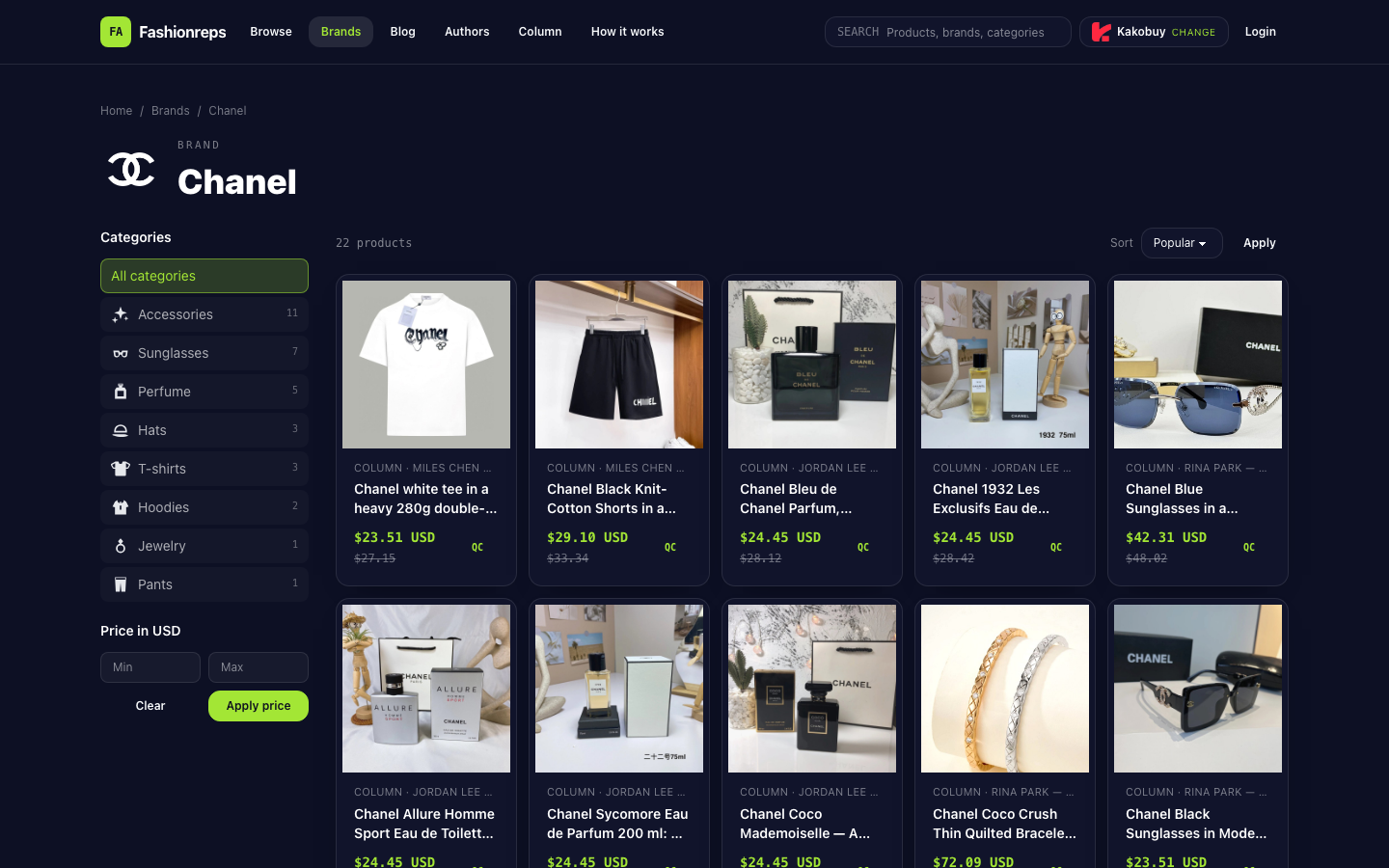
The above image is a schematic screenshot of the catalog page, used to illustrate the page structure of the product catalog and agent selection entry, not an official screenshot from any agent platform, nor does it constitute evidence of the actual product, QC, or hands-on testing.
Step 1: Lock in the Same Product First
Before comparing across different agents, first create a product identity record from the source catalog. At least save the following fields:
- Full text of the product title
- Product images and their position on the page
- Color, size, or specifications
- Source page URL
- Product number or original link identifier
- Current status displayed on the page
- Date the page was scraped or verified
The source catalog currently displays brand filtering, category filtering, price filtering, and product sorting functions, and lists 22 product entries. The catalog also categorizes accessories, sunglasses, perfume, hats, T-shirts, hoodies, jewelry, and pants under different categories. This information can only help locate the target entry in the catalog, and cannot independently prove that an agent page is still valid, nor that different agents display the same inventory or specifications.
If an agent page only shows a vague thumbnail, lacks color or size, or cannot map the product number back to the source catalog, you should pause the fee comparison. When identities are not aligned, subsequent QC and shipping figures may look lower but could correspond to a different product.
Step 2: Break Down Agent Comparison into Five Types of Evidence
Do not treat "has QC," "supports returns," or "low fees" as a vague conclusion. For each item, record the page facts, applicable conditions, and questions still to be verified.
| Comparison Field | Evidence Needed | Current Verdict |
|---|---|---|
| Product Entry | Can the target product be accessed from the source catalog to the agent order page, and do the title, specifications, and link match? | The catalog page shows agent selection entry, but current materials do not provide item-by-item evidence of the corresponding product pages for the three agents. |
| QC Support | Is there explicit description of QC photos, number of photos, inspection scope, fees, and handling? | The source catalog has QC fields, but this cannot replace the agents' official QC policies or specific order evidence. |
| Warehousing | Inbound notification, free storage period, overtime fees, package consolidation conditions | No verifiable platform terms currently available. |
| Returns | Application deadline, acceptable reasons, product responsibility, and return shipping costs | No verifiable platform terms currently available. |
| Fees | Product price, domestic shipping, service fee, international shipping, insurance, and surcharges | No fee evidence under the same product, same address, and same package conditions. |
This breakdown avoids misinterpreting the QC mark on the source catalog as proof that the agent has completed quality inspection. The catalog page description only indicates that the site provides product discovery, visible QC photos, and agent comparison information; orders, payments, and international shipping are handled by external agent sites.
Step 3: Verify Kakobuy, LitBuy, and USFans Separately
Kakobuy
Only base your verification on Kakobuy's official website or official materials for the order entry, product import method, QC description, warehousing policy, after-sales terms, and fee calculation pages. Currently no screenshots or textual evidence of these pages are provided, so specific button names, steps, rates, or free periods cannot be filled in.
When verifying, first confirm whether the platform can recognize the product link, then check whether the platform retains the original color, size, and quantity. Before entering settlement, save a page record of the product amount, service fee, domestic shipping, and international shipping options. If the page requires login to display key fields, mark it as pending login verification, rather than assuming the platform does not have that service.
LitBuy
The comparison method for LitBuy is the same: first verify the same product identity, then record QC, warehousing, returns, and fees separately. Do not assume that just because the source catalog allows selecting this agent, it currently supports a specific product link, nor apply policies from other platforms to LitBuy.
If the platform page does not publicly display fees, the final amount can only be based on the settlement page after login. For any still-missing handling fees, payment surcharges, or international shipping, do not use historical experience as a substitute for current evidence.
USFans
USFans should also be verified using the same set of fields. Pay particular attention to whether the product page automatically converts the title, specifications, or quantity, and whether the agent's internal number can be traced back to the source link. If only a generic search result is visible and the specific product cannot be confirmed, it cannot be used as a valid comparison sample for the same product.
Step 4: Check Final Settlement Page Under Unified Conditions
Only after the product identity is consistent is it appropriate to verify fees. It is recommended to fix the following conditions:
- Same product link
- Same color, size, and quantity
- Same destination country or region
- Same packaging requirements
- Same time window
- Same insurance and value-added service selections
Break down each platform's settlement page into separate fields to record: product amount, service fee, domestic shipping, warehousing or handling fee, international shipping, insurance, payment surcharge, and total. If any field is not displayed, write "not displayed" or "pending settlement page confirmation," not zero.
Also distinguish between estimated and actual payment amounts. Estimated shipping may depend on package weight, volume, route, and packaging method; the amount may change after warehouse weighing or repacking. Without current order conditions and settlement pages, it is impossible to determine which one is ultimately cheaper.
Step 5: Separate QC Evidence from Service Promises
QC photos can only answer some questions about product condition and cannot automatically prove material, authenticity, long-term durability, or after-sales results. When comparing, record:
- Whether photos for the corresponding order were actually uploaded
- Whether the photos clearly show the appearance, labels, size, and obvious defects
- Whether the platform states the inspection scope
- Whether additional photos or return requests are allowed
- The handling deadline and who bears the cost after problems are found
Service policies also depend on applicable conditions. For example, "supports returns" may only apply to unshipped, wrong item, or obvious quality issues, and may not cover buyer's subjective dislike, wrong size choice, or shipping damage. If the policy does not clearly state responsibility determination and return shipping costs, it can only be recorded as conditions unclear.
Final Decision: Pause When Evidence Is Insufficient, Not Rank
The current materials are sufficient to establish a catalog verification process, but insufficient to compare the real-time fees, QC quality, storage periods, or return results of the three agents. A more prudent judgment is: first complete the identity alignment of the same product, then obtain evidence from the official pages or order settlement pages of each of the three agents separately; if any key field is missing, keep it as pending verification.
Before ordering, you can review in the following order:
- Can the source title, images, specifications, and link correspond one-to-one with the agent page.
- Does the agent show a currently orderable status, not just search results or old links.
- Is the QC specific to the order, with clear photo scope and handling of exceptions.
- Do warehousing and return terms apply to the current product and order status.
- Does the final settlement page display all fee fields simultaneously.
- When fees, inventory, or service conditions change, save page evidence again.
Until these evidences are complete, the most reasonable next step is not to choose the "cheapest" agent, but to pause the purchase and fill in the missing fields. This is how to distinguish the product leads provided by the source catalog from the services and fees actually undertaken by the agent platform.
Continue reading