From the blog
Champion Hoodie Costs: Price, Fees & Shipping on FashionReps
After spotting Champion fall/winter hoodies on fashionreps, the first thing to resolve isn't whether the listed price is cheap—it's how much this hoodie will ul...
After spotting Champion fall/winter hoodies on fashionreps, the first thing to resolve isn't whether the listed price is cheap—it's how much this hoodie will ultimately cost, and which fees can only be confirmed after the agent platform, warehouse, or international logistics calculates them. This article focuses on a single Champion fall/winter hoodie and provides a pre-order cost checklist to help you decide whether to continue checking or hold off on payment.
This article applies to buyers who have already found a specific style and are about to enter the shopping agent or international shipping stage. It does not apply to vague price comparisons without a clear product page, visible size and style information, or a determined destination country. Fashionreps product and QC pages mainly serve as references for discovery and verification; orders, payments, and international shipping still need to be confirmed on the actual shopping agent page.
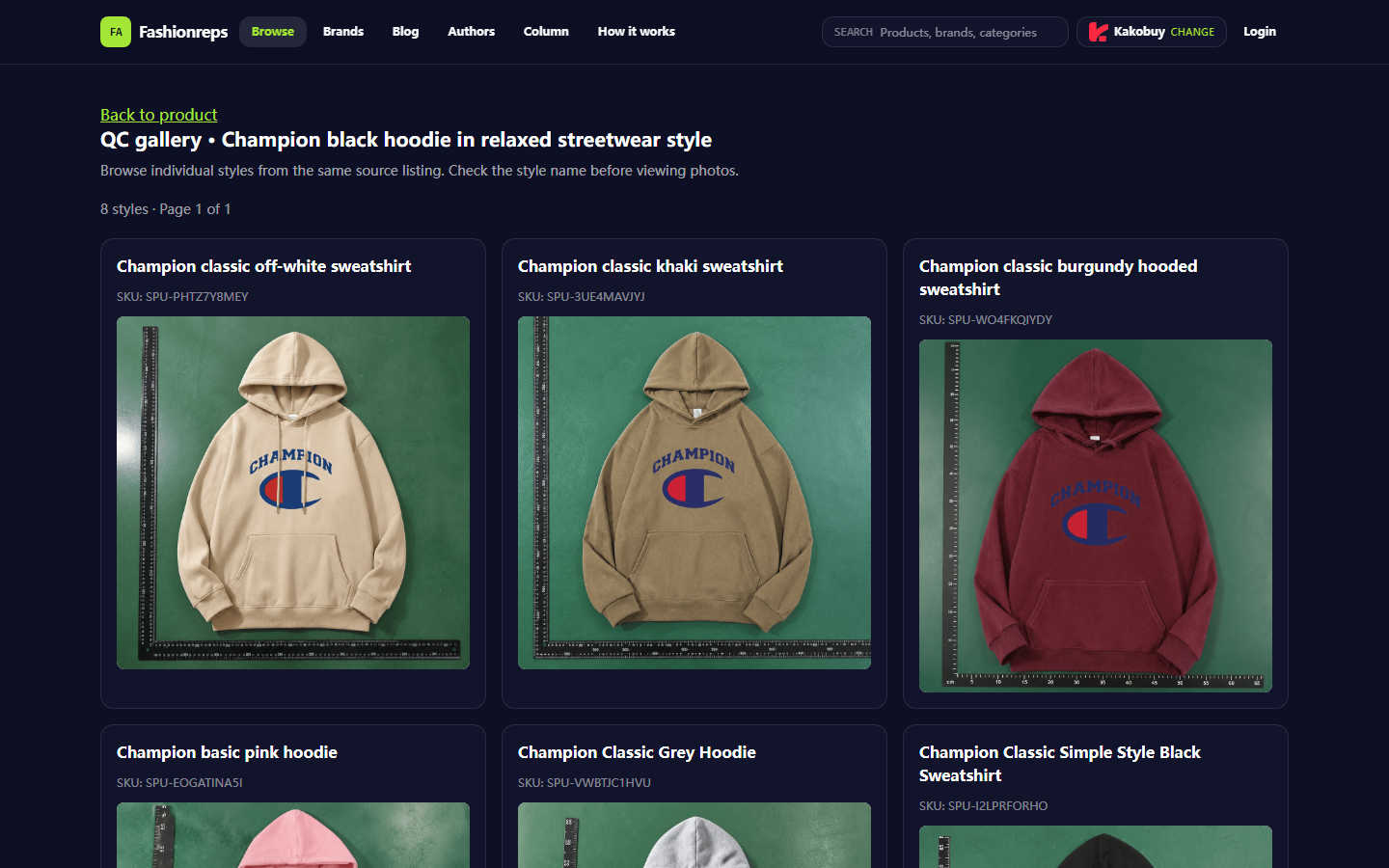
Image: Example of a QC page for a Champion black hoodie. Used to confirm the style entry, not to verify current price, stock, or international shipping cost.
Clarifying the Purchase Decision for Champion Fall/Winter Hoodie Package Costs
The specific question to answer before ordering is: after determining the style and size of this hoodie, can the item cost, agent service fee, payment-related fees, packaging fee, and international shipping cost to the destination country be separately recorded and verified?
After reviewing this checklist, you should be able to do three things:
- Confirm which Champion style and size the product page corresponds to.
- Record the item price, service fee, payment fee, packaging fee, and international shipping cost separately.
- Pause payment when fee evidence is incomplete, rather than deciding based on a vague total price.
The most important judgment: if the page only shows a product entry or QC images without current visible price, service fee rules, and destination shipping results, it cannot be treated as a complete quote.
Recording Style, Size, Currency, and Current Visible Price from the Product Page
Start by saving the fields you can directly see on the product page. Champion fall/winter hoodies may come in different colors, fits, hooded vs. crewneck, different sizes, or multiple styles from the same source. Similar images do not mean the same SKU; you cannot judge the price based only on black, gray, or the brand name.
Recommended to record the following:
- Product name and specific style name.
- SKU, variant, or style code shown on the product page.
- Color, size, and quantity.
- Currency of the product price shown on the page.
- Current visible product price, and which size and variant the price corresponds to.
- Page display time and time zone.
- Whether stock, pre-sale, seller changes, or price validity is noted.
Currently available page evidence confirms that the Champion product QC page has multiple independent style entries, but does not provide verifiable current product amounts, stock status, or size price differences. Therefore, this article does not output any specific product values. When you enter the actual product page, use the amount shown at that time and keep screenshots or order previews as records.
Distinguishing Item Price, Service Fee, Payment Fee, and Packaging Fee
When fee names are similar, double-counting can easily occur. For example, the agent platform may place the service fee on the checkout page, or calculate it separately based on product type, order amount, or payment method. Packaging fees may only appear during warehouse processing or international shipping.
| Fee Item | What to Check | What Not to Assume |
|---|---|---|
| Item Price | Specific style, size, quantity, currency, and current displayed amount | Different sizes are always the same price, or QC images correspond to the current sales variant |
| Service Fee | Fee percentage, fixed fee, applicable order range, and calculation base | If the page doesn't list it separately, it's free |
| Payment Fee | Payment method, currency conversion, payment channel surcharge, and minimum fee | The amount shown on the payment page is the final card charge |
| Packaging Fee | Reinforcement, box change, original packaging removal, weighing, or warehouse operation fees | Regular packaging is always suitable for long-distance shipping |
| International Shipping | Destination, route, chargeable weight, volumetric weight, package restrictions, and delivery time | Item price plus a fixed percentage can estimate shipping |
When recording, don't just write "total price". At minimum, save the name, amount, currency, calculation time, and evidence location of each fee. If a fee is not yet generated, mark it clearly as "to be queried", not zero.
Checking International Shipping Entry with Unified Destination and Package Conditions
International shipping cannot be compared independently of destination and package conditions. The same Champion hoodie, shipped to different countries or regions, may correspond to different routes, prohibited items rules, declaration requirements, fuel surcharges, and customs arrangements.
When entering the shipping query, record uniformly:
- Destination country and necessary state, province, or postal code range.
- Number of items in the package and general category.
- Whether original packaging, tags, or shoe boxes are kept.
- Estimated actual weight and possible volumetric weight.
- Available shipping routes, billing currency, and estimated delivery time.
- Whether final delivery, insurance, taxes, or customs clearance services are included.
- Date and time of the shipping query.
If the system has not yet generated a package weighing result, only record estimated conditions, and do not write the estimated shipping cost as the final cost. For a fall/winter hoodie, the garment itself may not be heavy, but with packaging it still needs to be based on actual warehouse weighing and route billing rules. Some routes compare actual weight and volumetric weight and charge the higher.
Consolidation cannot be automatically assumed to be cheaper. Multiple items may reduce repeated first weight or fixed handling costs, but may also increase package weight, volume, declared value, and single loss risk. Splitting may incur more fixed fees but may suit route restrictions or reduce per-package risk. The final decision should be based on actual samples, not applying the conclusion that "consolidation is always cost-effective".
Variables to Record for Single Purchase and Later Consolidation
If you are buying only this one Champion fall/winter hoodie, the focus is on confirming the single item price, single item handling fee, minimum chargeable weight, and destination route. If you later plan to consolidate with other items, you should recheck after the item arrives at the warehouse, rather than relying on the first estimate.
Single item records should include:
- Actual purchase price of the item.
- Service fee and payment fee of the single order.
- Actual weight after warehousing.
- Packaging method and weight or volume after packaging.
- Available routes and route restrictions.
- Estimated taxes, customs materials, and final delivery conditions.
Consolidation records should also add:
- Weight and volume of each item.
- Packaging changes before and after consolidation.
- Consolidation handling fee, box change fee, or reinforcement fee.
- Total declared value after consolidation.
- Whether available routes change after consolidation.
- Estimated savings and added risks.
Savings should be calculated as "confirmed costs of separate shipping minus confirmed costs after consolidation". If one side is still an estimate, it can only be called an estimated difference, not confirmed savings.
Preserving Evidence for Exchange Rates, Chargeable Weight, and Query Time
The same amount may use different currencies on the product page, agent checkout page, and bank card statement. Exchange rate changes, payment channel rates, and additional conversion fees can make the final charge differ from a simple conversion.
Recommend creating a fee record:
- Original amount and original currency.
- Converted reference amount and exchange rate source used.
- Exchange rate query time.
- Whether the payment channel uses its own exchange rate.
- Whether there are conversion fees or cross-border payment surcharges.
- Billing currency for international shipping.
- Actual weight, volumetric weight, and final chargeable weight.
- Corresponding page, order preview, or warehouse record for each value.
Do not directly add prices queried at different times, or mix currencies from the product page, service fee, and international shipping before rounding. First unify the currency before calculation, and keep original amounts after calculation to detect exchange rate or fee changes.
Currently available materials do not provide verifiable price, weight, destination, exchange rate, or shipping calculator results, so no credible savings or final total can be given. When these fields are missing, the safest approach is to continue gathering evidence, not using averages as substitutes.
Stop Conditions When Page Lacks Rates or Calculator Results
If any of the following occurs, pause payment or pause the "good deal" judgment:
- Product name exists, but specific style or size cannot be matched.
- Product price does not indicate currency, time, or applicable variant.
- Page only has QC images, no verifiable current purchase entry or checkout amount.
- Service fee, payment fee, or packaging fee does not explain calculation method.
- Destination country not determined, cannot select corresponding shipping route.
- Shipping calculator does not return a result, or result does not note weight and time conditions.
- Estimated weight differs significantly from actual warehouse weighing, but system does not re-quote.
- Taxes, customs materials, or import restrictions are not clearly stated.
- Checkout page total cannot be reconciled with fee breakdown.
These stop conditions do not mean the product is not worth buying, but that current evidence is insufficient to support payment. Especially do not skip checking style, size, service fee, and international shipping conditions just because a price looks low.
Final Action: After Completing the Fee Checklist, Decide to Continue Verification or Hold
Before continuing verification, first organize this Champion fall/winter hoodie into a complete fee record: specific style and size, item price, currency, service fee, payment fee, packaging fee, destination, actual or estimated weight, international shipping, tax conditions, and query time. Each item should be marked as confirmed, to be queried, or estimate only.
Only proceed to the next step of payment judgment when the product variant is clear, item price is visible, fee items can be broken down, destination shipping is returned, and exchange rate and chargeable weight have time records.
Consolidation savings must come from your actual package sample; added risks include higher package value, volumetric weight, route restrictions, and single loss exposure. It is more suitable for buyers who have multiple items, can obtain actual warehouse weights, and are willing to compare different routes. It is not recommended to consolidate solely for expected shipping savings when weight, taxes, customs conditions, or route restrictions are still unclear.
If you can only see product images and style entries but cannot obtain price, service fee, and destination shipping results, it is recommended to hold off on ordering and first complete the fee checklist and actual quote verification. 🧾 📦 💱 🔍 ✅
Continue reading