From the blog
Burberry Scarf Links: Spreadsheet vs Sheets
When organizing Burberry scarf candidates, the real task isn't just copying items into another sheet—it's verifying whether each record still leads back to the...
When organizing Burberry scarf candidates, the real task isn't just copying items into another sheet—it's verifying whether each record still leads back to the original page, and distinguishing between size info you've already seen, fields that still need to be filled in, and stock or price details that can't be inferred from how the page looks. This article uses the product catalog visible on fashionreps and the website-based spreadsheet as a starting point, explaining how to transfer candidate data into Google Sheets and then re-check size, color, links, and verification status item by item.
This guide is for anyone who needs to organize multiple candidates, compare different link states, or have other collaborators continue the review. It's not a substitute for product detail pages, QC photos, seller pages, or shopping agents' real-time order info. Page content, seller profiles, and link statuses change over time, so the following process should be based on the date you actually open the page; this method was recorded on October 16, 2026. 🧣
Define the verification task for organizing Burberry scarf candidates
First, write the task as an actionable step: find Burberry scarf candidates from the fashionreps catalog, record fields that are directly visible on the page, then filter in Google Sheets to identify records with missing sizes, broken links, or ones that need to be reopened for confirmation.
When done, the table should at least answer these questions:
- Does this record still open the original product or catalog page?
- Does the page clearly show the product name or style name?
- Are the sizes explicitly listed as values on the page, or not provided?
- Is there text evidence for color, material, or other attributes?
- Do the images or QC pages belong to the same candidate, not just similar styles?
- What's the date this record was last verified?
Don't write down "looks like a scarf" or "has a check pattern in the image" as confirmed material, size, or brand info. For anything you can't confirm from the page, using "pending verification" is more useful than filling in guesses. 🔎
Which visible fields to record first in fashionreps' website-based spreadsheet
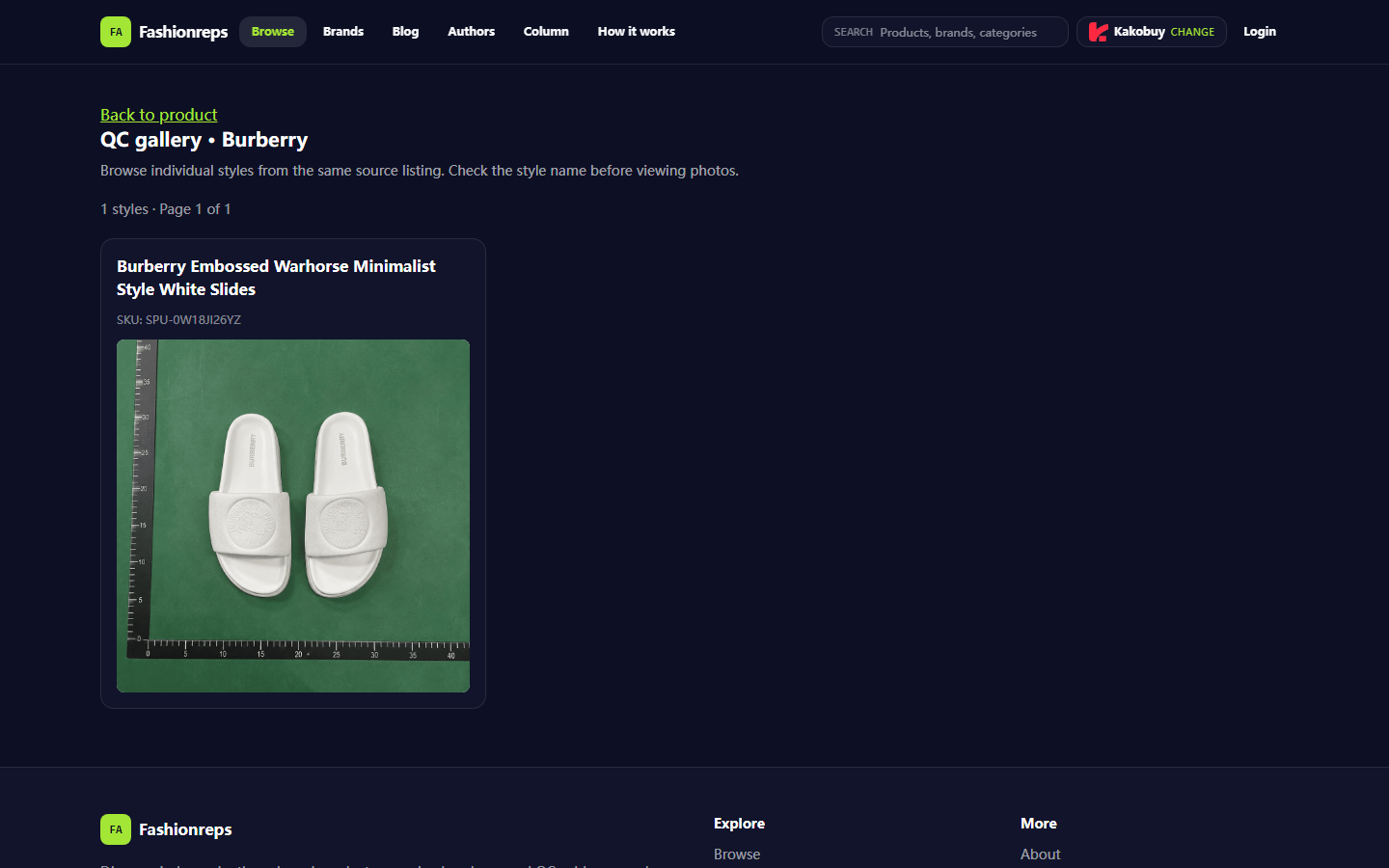
When you open a candidate page, start by recording what's directly shown on the page—don't copy long descriptions right away. The website-based catalog is good for discovering candidates, browsing by brand or category, and returning to product pages to check images, names, and available entry points. The currently visible Fashionreps page includes brand browsing, product catalog, QC photo entry, and shopping agent selection entry; orders, payment, and shipping are handled by the selected agent's website, so these steps can't be confirmed by the catalog page itself.
For the first pass, I recommend using these minimal fields:
- candidate_id: custom ID, e.g., BUR-SCARF-001.
- item_name: product name or style name shown on the page.
- brand: brand category the page is under; don't judge only from the image.
- source_page: original page URL, test it once immediately after copying.
- imageorqc_page: if the page provides a corresponding image or QC entry, record that separately.
- visible_size: sizes explicitly written on the page; if none, write "not shown".
- visible_color: colors explicitly written on the page; if none, write "not shown".
- visible_material: fill only when there's text evidence on the page.
- link_status: pending verification, opens, redirects, broken, or requires login, etc.
- checked_at: date you actually opened the page this time.
- note: record missing fields, page changes, or reasons for needing a second confirmation.
The website page is better for first-hand observation. It helps you confirm where the candidate came from and what's on the page, but you shouldn't treat the category names in the catalog as complete product specs, nor treat the shopping agent selector as proof of order status. 📷
How to set up size, color, link, and verification status columns in Google Sheets
After transferring candidates into Google Sheets, the key is to make each field have only one meaning. Don't stuff size, color, and notes all into a single "product info" cell, or filtering will become difficult later.
You can set up headers in this order:
| Field | How to fill | Review focus |
|---|---|---|
| candidate_id | Unique ID for each candidate | Avoid importing the same candidate twice |
| item_name | Copy visible name from page | Don't rewrite into a more complete name |
| source_page | Save original page URL | Prioritize opening this column later |
| visible_size | Original size or "not shown" | Don't infer size from image proportions |
| visible_color | Explicit color from page or "not shown" | Distinguish color name from personal impression |
| link_status | Use fixed status terms | Record open result, not subjective evaluation |
| checked_at | Record actual verification date | Update when page changes |
| missing_fields | List missing fields | For focused follow-ups |
| reviewer_note | Write reasons and next steps | Don't write unverified conclusions |
For easier collaboration, limit link_status to a few fixed values: pending verification, opens, redirects, broken, insufficient info, requires login. Fixed statuses are easier to filter than everyone writing free-form notes like "seems to open" or "link has some issues".
Keep size fields in their original format. For example, if the page says "180 cm × 30 cm", record it as is; if you need to convert or compare, add separate columns like normalizedlength and normalizedwidth and explain the conversion method in notes. This preserves the source and avoids mistaking your estimates for the page's original values. 📊
Step-by-step comparison of search and filtering flow between the two tools for the same candidate
Step 1: Browse by brand or related category in the fashionreps catalog, find a candidate, then open its detail or image entry. Record the page name, original URL, and specs visible at that moment—don't just save the search results page.
Step 2: Create a new row in Google Sheets and fill in candidateid, itemname, and sourcepage first. Keep linkstatus as "pending verification" until you reopen the page from the URL in the sheet.
Step 3: Go back to the original page and check size, color, and material fields. Only content explicitly shown on the page goes into the corresponding column; anything missing goes into missing_fields rather than filling in based on adjacent items.
Step 4: In Google Sheets, filter by linkstatus, missingfields, or checked_at. For example, first filter for "opens" and "size not missing" records, then handle "insufficient info" records separately. This separates candidate discovery from data auditing.
Step 5: If the page title or content changes, don't overwrite previous judgments. Update checkedat and write the reason in reviewernote, like "name changed after reopening" or "original page inaccessible". Keeping a change log helps determine whether a link is temporarily glitchy or the candidate is no longer worth comparing.
The division of labor between the two tools can be summarized as: the website-based spreadsheet is for discovering and reviewing catalog context, while Google Sheets is for structured recording, filtering, and collaborative review. They are not the same data source, and you shouldn't automatically assume that a blank in Google Sheets means the original page lacks that information. ✅
How to verify product links, page update times, and missing fields
Link verification should at least observe three things: whether it opens successfully, whether the opened page still matches the same candidate, and whether the page has enough visible information to support your records. Just getting a web response doesn't mean the product page is still valid; if it redirects to the homepage, brand catalog, or a blank page, mark it as redirected or insufficient info.
Check in this order:
- Copy source_page from Google Sheets and open it in a browser.
- Compare the page title, brand category, and product name to confirm it's not a similar style or a pure catalog page.
- See if the page still has enough visible fields like name, images, or specs.
- If the page shows a date, update time, or content version, record it as is; otherwise write "not shown".
- Write the verification result into linkstatus and checkedat.
- For records missing size, color, or material, fill in missing_fields.
"Page update time" and "verification date" are not the same field. The former is time info provided by the page, the latter is when you actually open and check it. If the page doesn't have an update time, don't use today's date to fake it; just record the verification date.
If a product page opens but doesn't have enough specs to support comparison, the status can be "insufficient info" rather than "usable". "Opens" only means the address is accessible; "usable for size comparison" requires meeting field completeness criteria separately. 🕒
Operational boundaries when viewing images, copying links, and returning to pages on mobile
Mobile is fine for quickly viewing images, copying page URLs, and marking items as pending verification, but the small screen can easily hide full fields, truncate titles, or cause accidental back navigation. For sizes and link statuses, treat mobile records as preliminary checks; re-confirm important candidates on a larger screen.
When operating on mobile, follow these boundaries:
- After copying a link, paste it into the sheet or a temporary check location first; don't rely solely on browser history.
- When viewing images, confirm the image belongs to the current candidate page—don't mistake adjacent recommendations for the same item.
- After returning to the page, re-confirm the title and brand position to avoid going back to search results and editing the wrong candidate.
- If you can't see the full size, record "not shown on mobile" instead of filling in a number based on image proportions.
- Avoid saving or sharing screenshots that include personal orders, addresses, payment info, or complete shipping labels; if necessary, redact personal information.
If the mobile page only shows images without spec text, the safest record is "image visible, size pending verification". Images help locate the candidate but cannot replace text specs or measurement data. 📱
Scenarios where the website catalog and Google Sheets are each suitable or not
The website-based spreadsheet is good for discovering candidates within an existing catalog, browsing brand context, and opening product images or QC entries. It's not suitable for long-term field auditing, and especially not for confirming stock, shipping, orders, payment, or shipping status on behalf of agent sites.
Google Sheets is good for establishing unified fields, filtering missing items, assigning review tasks, and keeping verification dates. It's not suitable for auto-generating product facts without original page evidence, nor should you treat manually entered statuses as real-time stock or price.
When the goal is to quickly discover a few candidates, using the website catalog first is more convenient; when the goal is to verify size fields, re-check links, or collaborate with multiple people on several candidates, switch to Google Sheets. If you only need to view one product's details, opening the original page directly might be more appropriate than building a full table.
How to mark pending verification items when info is insufficient, and avoid inferring stock or price
Insufficient info isn't a failure state; it's a signal to clarify next steps. Break down missing content into specific tasks like "pending confirmation of scarf length", "pending confirmation of color name", or "pending reopening of source page", rather than writing vague "incomplete info".
The following should not be inferred from images, brand categories, or adjacent candidates:
- Current stock or available quantity.
- Current price, discount, or shipping cost.
- Material composition, weight, or hand feel.
- Exact dimensions and tolerance ranges.
- Seller identity, shipping location, or after-sales policy.
- Whether the item is authentic or guaranteed to pass platform review.
If the page doesn't explicitly give price or stock, write "not shown" separately, not "in stock", "reasonable price", or "should be buyable". If a product link is broken, don't guess the original candidate from similar images in search results. This way, future collaborators know what needs re-verification instead of propagating guesses to other sheets. ⚠️
Final action: build a reviewable Burberry scarf candidate table
After the first round of organization, first filter records with linkstatus of "pending verification", "redirects", "broken", and "insufficient info", and go back to sourcepage one by one to check. Then filter records where visible_size is "not shown" and confirm whether you need to find page specs, seller measurements, or QC info. When there's no reliable source, keep it as pending verification; don't fill the table with estimates.
Finally, keep candidateid, original page URL, visible fields, missing fields, link status, and verification date for each candidate. If collaborating with others, add reviewernote to specify who needs to do what and what needs confirmation. Update the date and notes whenever the page changes, and avoid overwriting original judgments.
The value of this method isn't making all candidates look complete—it's making every conclusion traceable back to the source page. The website catalog provides browsable candidate context, Google Sheets organizes size, color, links, and verification status into reviewable records; for stock, price, or material info the page doesn't provide, the most reliable result is still to explicitly mark it as unknown.
Continue reading